Capacitor Failure Signs Every Homeowner Should Know
Capacitor Failure Signs Every Homeowner Should Know
Your air conditioner was working perfectly last week. Now it's struggling to cool your home, making strange noises, or refusing to turn on altogether. Before you panic about a costly system replacement, there's a good chance you're dealing with something much simpler: a failed AC capacitor.
Capacitor failure is one of the most common HVAC problems homeowners face, yet most people don't know what warning signs to watch for. In this guide, you'll learn exactly what AC capacitor failure signs look like, why they happen, and what to do when you spot them.
What Is an AC Capacitor and Why Does It Matter?
Think of your AC capacitor as a battery that gives your air conditioning motors the electrical boost they need to start and run. Every time your system kicks on, the capacitor releases stored energy to get the compressor and fan motors spinning.
There are two main types of capacitors in most HVAC systems:
Start capacitors provide the initial jolt of power to get motors running. Once the motor reaches operating speed, the start capacitor disengages.
Run capacitors keep motors running smoothly after startup. They stay engaged throughout the entire cooling cycle, maintaining consistent motor performance.
Many modern air conditioners use a dual capacitor that combines both functions in a single cylindrical component. When this fails, both the compressor and fan motor lose the electrical support they need.
Without a functioning capacitor, your HVAC system can't operate properly—or at all. That's why recognizing the warning signs early can save you from a complete system shutdown on the hottest day of summer.
How Long Do AC Capacitors Last?
Most AC capacitors last between 10 to 20 years under normal conditions. However, several factors can shorten their lifespan:
- Heat exposure: Extreme summer temperatures put extra stress on capacitors
- Electrical surges: Power fluctuations from storms can damage internal components
- Manufacturing defects: Lower-quality capacitors may fail prematurely
- System cycling: Frequent on-off cycles wear out capacitors faster
- Poor maintenance: Dirty condenser coils force motors to work harder
If your air conditioner is more than 10 years old, capacitor failure becomes increasingly likely. Understanding the symptoms helps you catch problems before they cause secondary damage to other expensive components.
Top AC Capacitor Failure Signs to Watch For
1. Your AC Won't Turn On at All
This is the most obvious sign of a failed capacitor. You adjust the thermostat, but nothing happens. The outdoor unit sits silent even though the thermostat is calling for cooling.
When a capacitor completely fails, the compressor and fan motors can't start without that initial electrical boost. The system has power, but the motors remain motionless.
What to check: Before assuming it's the capacitor, verify your circuit breaker hasn't tripped and your thermostat is set correctly. If everything else checks out, a dead capacitor is the likely culprit.
2. Delayed or Sluggish Startup
A failing capacitor often gives warning signs before dying completely. If your AC takes longer than usual to start after the thermostat calls for cooling, the capacitor is losing its ability to store and release energy efficiently.
You might notice:
- A 10-30 second delay between thermostat adjustment and system startup
- The outdoor fan spinning slowly before reaching normal speed
- Multiple attempts before the compressor finally kicks on
This "hard starting" symptom indicates the capacitor is weakening but hasn't failed entirely. Addressing it now prevents a complete breakdown later.
3. Humming or Clicking Noises from the Outdoor Unit
Strange sounds from your condenser unit are classic bad AC capacitor symptoms. Here's what different noises mean:
Humming: A continuous humming sound means the compressor is trying to start but can't overcome initial resistance without a strong capacitor boost. The motor receives power but lacks the torque to begin spinning.
Clicking: Repeated clicking every few seconds indicates the capacitor is attempting to release energy but can't maintain an electrostatic charge. This creates an electrical "chattering" as the system repeatedly tries and fails to start.
Buzzing: A buzzing noise suggests electrical current is flowing but motors aren't engaging properly due to insufficient capacitance.
If you hear any of these sounds, turn off your system immediately. Running a motor that can't start properly generates excessive heat and can damage the compressor—a much more expensive repair.
4. The System Turns Off Randomly (Short Cycling)
Short cycling happens when your AC turns on, runs for a few minutes, then shuts off before completing a cooling cycle. This on-off pattern repeats throughout the day.
A failing run capacitor can cause this because it can't maintain consistent voltage to the motors. As the capacitor heats up during operation, its already-diminished capacity drops further, forcing the system to shut down as a protective measure.
Short cycling doesn't just indicate a capacitor problem—it also wastes energy and puts stress on every component in your HVAC system. If you've noticed this pattern, schedule an HVAC repair inspection soon.
5. Weak Airflow or Reduced Cooling Power
When your run capacitor starts failing, the blower motor can't maintain its normal speed. You'll notice:
- Weak air coming from vents even on high fan settings
- Some rooms cooling better than others
- The system running constantly but struggling to reach the set temperature
The capacitor isn't providing enough sustained power for the fan motor to push air through your ductwork at full capacity. This reduces your system's overall cooling efficiency and makes your home uncomfortable.
6. Rising Energy Bills Without Explanation
A failing capacitor forces your HVAC motors to work much harder than designed. When motors struggle without proper electrical support, they draw more current from your electrical system.
Compare your recent utility bills to the same months last year. If you notice a 10-20% increase without a corresponding change in weather or usage patterns, a weak capacitor could be the hidden culprit draining your wallet.
The longer you wait to replace a failing capacitor, the more you'll pay in wasted electricity. Plus, overworked motors have shorter lifespans, potentially leading to even bigger repair bills down the road.
7. Burning Smell Near the Outdoor Unit
A burning or acrid smell coming from your condenser unit is a serious warning sign. When motors can't start properly or run inefficiently due to capacitor failure, they overheat.
This smell might indicate:
- Motor windings overheating from excessive current draw
- Electrical components deteriorating inside the capacitor
- Insulation breaking down on wiring connections
Important safety note: If you smell burning, turn off your AC immediately at the thermostat and the circuit breaker. Don't attempt to investigate further—call a professional HVAC technician right away. Continuing to run the system could start an electrical fire.
8. Visual Signs of Capacitor Damage
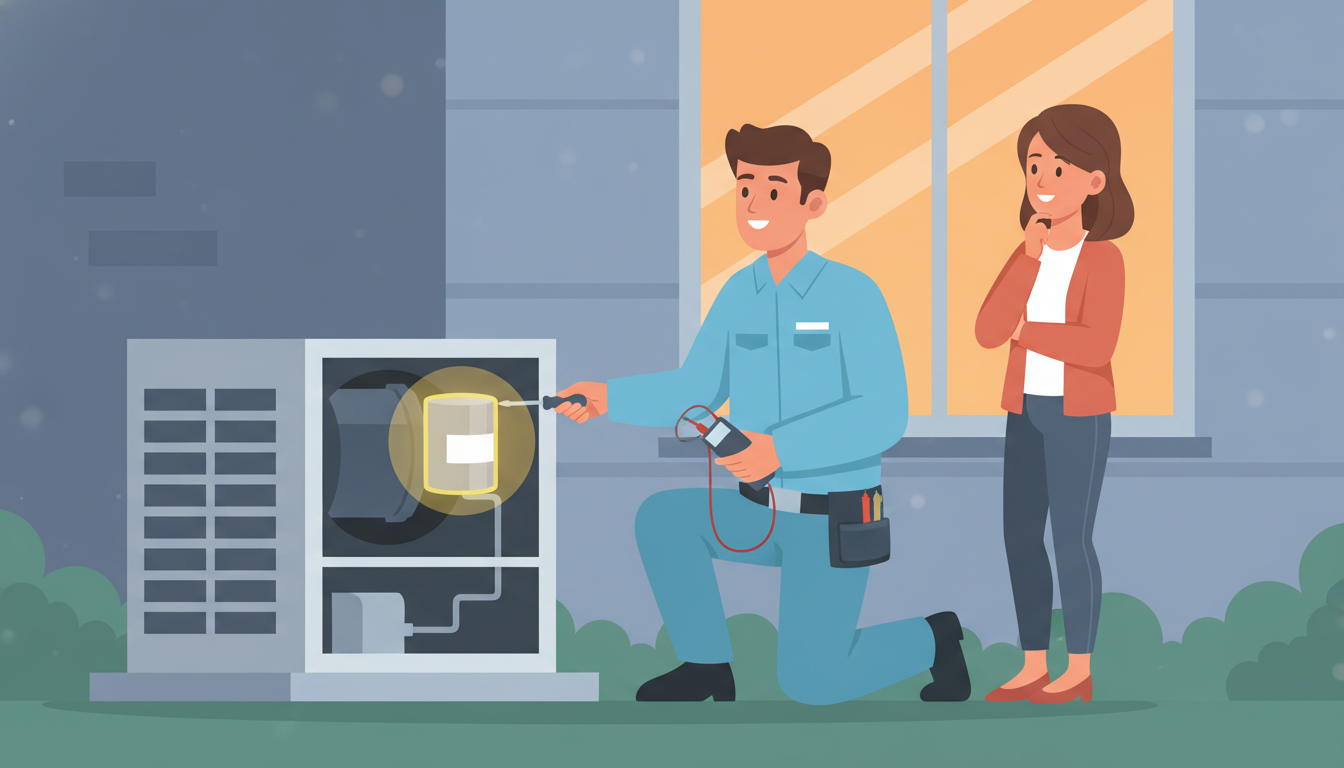
If you're comfortable opening your outdoor unit's access panel (with power OFF), you can visually inspect the capacitor. Look for these physical warning signs:
- Bulging or swelling: The cylindrical body should be smooth, not expanded or domed
- Rust or corrosion: Moisture exposure causes deterioration
- Leaking fluid: Oily residue around the base indicates internal failure
- Burn marks: Discoloration or charring on the capacitor or nearby wiring
- Cracked casing: Physical damage compromises the capacitor's integrity
Any of these visual cues mean the capacitor needs immediate replacement. Never touch a capacitor, even with power off—they store dangerous electrical charges that can deliver a severe shock even when disconnected.
9. Your Circuit Breaker Keeps Tripping
When your HVAC breaker keeps tripping, a failing capacitor is a common cause. Here's why this happens:
A weak capacitor can't provide the voltage support motors need, forcing them to draw excessive current directly from your electrical panel. This increased amperage triggers the breaker as a safety protection.
While a tripped breaker has many possible causes, if it happens repeatedly when your AC tries to start, the capacitor should be one of the first components checked.
What Causes AC Capacitor Failure?
Understanding why capacitors fail helps you prevent future problems:
Heat Stress
Your outdoor condenser unit sits in direct sunlight, often reaching 150°F or higher in summer. This constant heat exposure degrades the dielectric material inside capacitors that stores electrical charge.
Electrical Surges and Lightning
Power fluctuations from storms, lightning strikes, or utility switching can overwhelm a capacitor's voltage rating. Even a brief surge can permanently damage internal components.
Age and Normal Wear
Capacitors have a finite lifespan. The repeated charging and discharging cycles gradually break down the electrostatic field until the component can no longer function.
Poor Ventilation
If your outdoor unit is crowded by vegetation, fencing, or debris, it can't dissipate heat properly. This accelerated aging affects capacitors first since they're heat-sensitive.
Manufacturing Quality
Not all capacitors are created equal. Generic or low-quality replacements may fail much sooner than OEM (original equipment manufacturer) parts designed specifically for your system.
Can You Run Your AC with a Bad Capacitor?
Technically, yes—sometimes. If the capacitor is weakening but hasn't completely failed, your system might still operate, albeit poorly. However, you absolutely shouldn't.
Here's what happens when you keep running your AC with a bad capacitor:
Compressor damage: The compressor motor works much harder without proper capacitor support. This excessive strain can cause the compressor to overheat and burn out—a repair that often costs $1,500-$2,500.
Fan motor failure: Like the compressor, your fan motor suffers when the run capacitor can't maintain proper voltage. Fan motor replacement typically runs $300-$600.
Complete system breakdown: A failed capacitor puts stress on every electrical component. What starts as a $150-$400 capacitor replacement can escalate into a $3,000+ repair bill or full system replacement.
The smart move? Address capacitor problems immediately when you notice the warning signs.
How HVAC Technicians Diagnose a Bad Capacitor
Professional HVAC technicians use several methods to confirm capacitor failure:
Visual Inspection
Trained eyes spot the physical warning signs—bulging, leaking, corrosion, or burn marks—that clearly indicate failure.
Multimeter Testing
A digital multimeter measures voltage and resistance. Technicians check whether the capacitor can hold and release charge within the specified voltage rating printed on the component.
Capacitance Testing
A specialized capacitance meter measures the actual microfarads (µF) the capacitor can store compared to its rated capacity. If the measured value is 5% or more below the rating, replacement is recommended.
Amp Draw Testing
By measuring how much current the motors draw during startup and operation, technicians can determine if the capacitor is providing adequate electrical support.
AC Capacitor Replacement: What to Expect
Should You DIY or Hire a Professional?
Capacitor replacement might look simple on YouTube, but it's genuinely dangerous for untrained homeowners. Here's why professional installation is strongly recommended:
- Capacitors store lethal electrical charges even after power is disconnected
- Incorrect discharge procedures can cause serious injury or death
- Installing the wrong capacitor rating damages motors and voids warranties
- Improper wiring creates fire hazards
- Most states require licensed HVAC technicians for electrical work
For your safety: Unless you're a trained HVAC professional, always hire a licensed technician for capacitor replacement.
Cost of AC Capacitor Replacement
Professional capacitor replacement typically costs between $150-$400, depending on:
- Your location and local labor rates
- The type of capacitor (single vs. dual)
- Emergency service fees for after-hours calls
- Whether you need a start capacitor, run capacitor, or both
This is one of the most affordable HVAC repairs, especially compared to compressor or full system replacement. Many homeowners are pleasantly surprised by the reasonable cost.
How Long Does Replacement Take?
A skilled HVAC technician can safely replace an AC capacitor in 15-30 minutes. The process includes:
- Shutting off all power to the unit
- Safely discharging the old capacitor
- Removing and properly disposing of the failed component
- Installing the new capacitor with correct wiring
- Testing the system to verify proper operation
You'll have your AC back up and running the same day, usually within an hour of the technician's arrival.
How to Prevent Capacitor Failure
While all capacitors eventually fail, you can maximize their lifespan with these preventive measures:
Schedule Regular HVAC Maintenance
Annual tune-ups catch weakening capacitors before they fail completely. Technicians test capacitance levels and replace components showing early warning signs.
Keep Your Outdoor Unit Clean
Clear vegetation, leaves, and debris from around your condenser unit. Maintain at least 2 feet of clearance on all sides for proper airflow and heat dissipation.
Install a Surge Protector
A whole-house surge protector or dedicated HVAC surge protection device shields capacitors from voltage spikes caused by lightning or electrical grid fluctuations.
Replace Your AC Filter Regularly
Dirty air filters restrict airflow, forcing your system to work harder and cycle more frequently. This extra strain accelerates capacitor wear. Change filters every 1-3 months depending on your system and household.
Don't Ignore Small Problems
Unusual noises, slight delays in startup, or minor performance issues are early warning signs. Addressing them quickly prevents a small problem from becoming a major failure.
If you're experiencing any disconnect box problems outside your condenser unit, get that checked too—electrical issues often go hand-in-hand with capacitor stress.
When to Call for Emergency AC Service
Some capacitor symptoms require immediate professional attention:
- Burning smell: Indicates dangerous overheating
- Smoke from the unit: Potential electrical fire hazard
- Repeated breaker trips: Suggests serious electrical problems
- Complete system shutdown during extreme heat: Health risk for vulnerable family members
For these situations, call an HVAC emergency service rather than waiting for regular business hours.
Frequently Asked Questions
How do I know if my AC capacitor is bad?
The most common signs include your AC not turning on, humming noises from the outdoor unit, delayed startup, short cycling, weak airflow, rising energy bills, and burning smells. Visual inspection may reveal a bulging or leaking capacitor.
Can a bad capacitor damage my compressor?
Yes. When the capacitor fails, the compressor motor works much harder to start and run, causing excessive heat buildup. This stress can permanently damage compressor windings, leading to a costly replacement that often costs $1,500-$2,500 or more.
How much does it cost to replace an AC capacitor?
Professional AC capacitor replacement typically costs between $150-$400, depending on your location, the type of capacitor needed, and whether you require emergency service. This is one of the most affordable HVAC repairs.
How long should an AC capacitor last?
Most AC capacitors last 10-20 years under normal conditions. However, factors like extreme heat exposure, electrical surges, frequent cycling, and poor maintenance can shorten their lifespan significantly.
Can I replace my AC capacitor myself?
While technically possible, DIY capacitor replacement is not recommended unless you're a trained HVAC professional. Capacitors store lethal electrical charges even when power is off, and improper handling can cause serious injury or death. Incorrect installation can also damage your system and create fire hazards.
Don't Wait Until Your AC Dies Completely
Recognizing AC capacitor failure signs early saves you money, prevents secondary damage, and keeps your home comfortable. The symptoms are clear: strange noises, delayed startup, weak cooling, rising bills, or a complete shutdown.
If you've noticed any of these warning signs, don't wait for a complete breakdown. A simple capacitor replacement costs a fraction of what you'll pay if a failed capacitor damages your compressor or other major components.
Ready to get your AC running smoothly again? Contact a licensed HVAC technician today for a professional diagnosis. Most capacitor replacements are completed within an hour, and you'll have peace of mind knowing your system is protected from further damage.
Your comfort is worth the small investment in timely repairs. Don't let a $200 capacitor problem turn into a $3,000 system emergency.