Why Dirty Filters Cause So Many HVAC Repair Calls
Why Dirty Filters Cause So Many HVAC Repair Calls
Ever wonder why your HVAC technician keeps coming back? You're not alone. Dirty filters cause more HVAC repair calls than any other single issue, and most homeowners don't realize the damage happening behind their vents until it's too late.
Here's the reality: 29% of homeowners never change their air filter, and 82% don't do it monthly. That simple oversight turns into expensive service calls, emergency repairs, and a shortened lifespan for your entire HVAC system.
The Shocking Truth About Dirty Filters and HVAC Repairs
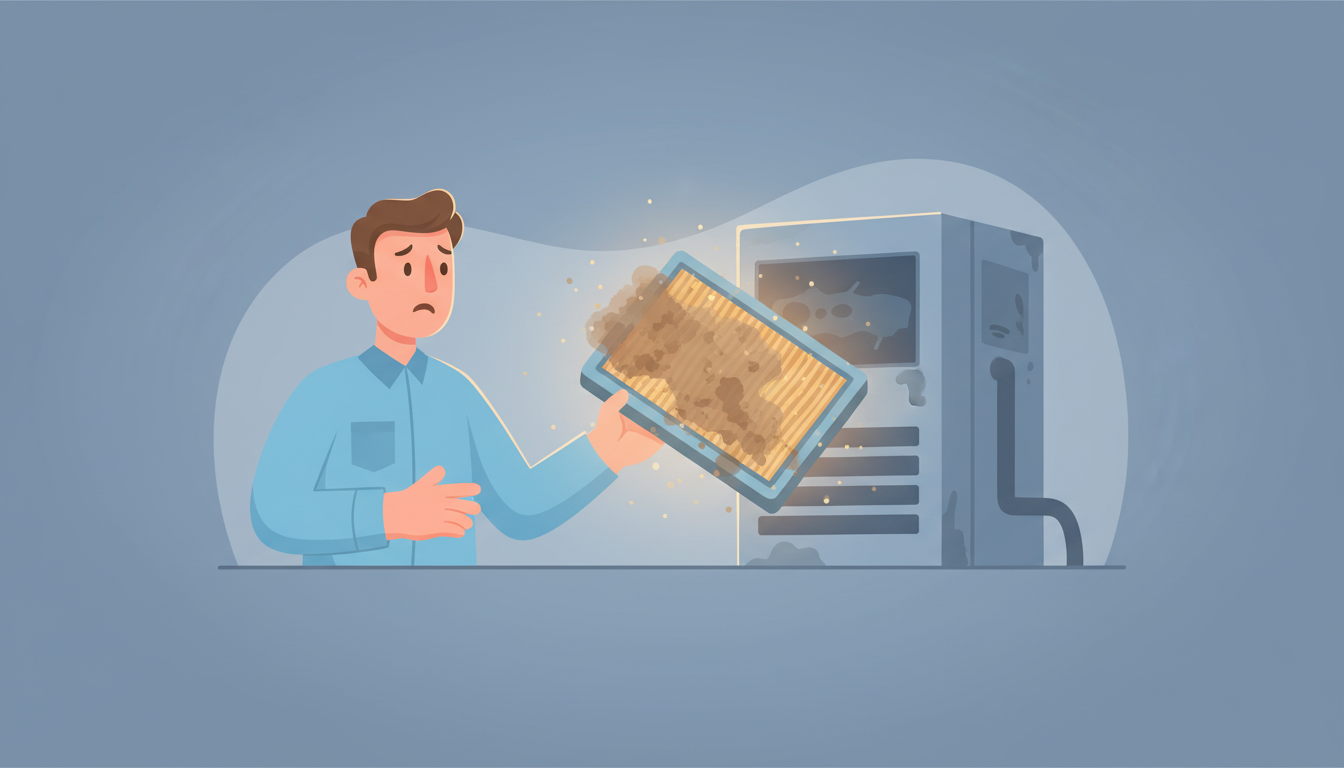
Your HVAC filter does more than clean your air—it protects thousands of dollars worth of equipment. When that filter gets clogged with dust, pet hair, and debris, it becomes a ticking time bomb for your system.
A dirty HVAC filter restricts airflow through your system. Think of it like breathing through a straw—your HVAC has to work twice as hard to push air through a blocked filter. That extra strain shows up in ways you can see (higher energy bills) and ways you can't (internal component damage).
According to the U.S. Department of Energy, a clogged air filter causes your HVAC system to use 15% more energy. For a home with a $150 monthly energy bill, that's an extra $270 wasted every year. But energy costs are just the beginning of the problem.
How a Clogged Air Filter Leads to Costly AC Problems
When airflow gets restricted, your HVAC system can't function the way it was designed. The reduced air circulation creates a domino effect of problems throughout your system.
First, your blower motor has to work harder to pull air through the clogged filter. This constant strain wears down the motor faster than normal, shortening its lifespan by years.
Second, without proper airflow, your evaporator coils can't absorb heat efficiently. The refrigerant temperature drops too low, and ice starts forming on the coils. Once ice appears, your cooling stops completely.
Third, the compressor—the most expensive component in your AC system—cycles on and off more frequently. This behavior, called short cycling, puts enormous stress on the compressor and can lead to premature failure.
Understanding the relationship between HVAC maintenance and repair helps you see why prevention matters so much.
The Most Common HVAC Repair Calls Caused by Dirty Filters
HVAC technicians see the same problems again and again, and dirty filters are almost always the culprit. Here are the repair calls that could have been prevented with a clean filter.
Frozen Evaporator Coils
This is the number one repair call caused by dirty filters. When your filter is clogged, restricted airflow prevents your evaporator coils from absorbing heat properly. The coils get too cold, and ice forms.
You'll notice ice buildup on the refrigerant lines outside your home, or water pooling around your indoor unit as the ice melts. Your AC will blow warm air or stop working entirely.
The repair call typically costs between $250 and $700 to diagnose and fix, plus the cost of any damaged components. All because of a $5 filter.
Blower Motor Failure
Your blower motor is designed to move air freely through your system. A dirty filter forces it to work against constant resistance, like running a marathon with weights strapped to your legs.
Over time, this extra workload overheats the motor and burns it out. Replacing a blower motor costs $450 to $800 on average, not including labor. That's a painful price for neglecting a simple filter change.
Compressor Damage
The compressor is the heart of your AC system, and it's also the most expensive component to replace. When dirty filters cause your system to short cycle, the compressor turns on and off repeatedly throughout the day.
Each startup puts stress on the compressor. Too much stress leads to mechanical failure. A compressor replacement can cost $1,500 to $2,500, and in some cases, it's more cost-effective to replace the entire system.
If you've noticed strange problems with your HVAC, check out this comprehensive HVAC repair guide to understand what's happening.
Complete System Shutdown
In extreme cases, a severely clogged filter causes your entire HVAC system to shut down. Safety switches detect the abnormal operating conditions and turn everything off to prevent damage.
While this shutdown protects your equipment, it leaves you without heating or cooling until a technician can diagnose the problem. Emergency service calls outside business hours often cost double or triple the normal rate.
The Real Cost of Ignoring Your Filter
Let's talk numbers. A standard HVAC air filter costs $5 to $30 depending on quality. If you change it monthly during peak seasons, you'll spend $60 to $120 per year on filters.
Now compare that to repair costs:
- Service call diagnostic fee: $75 to $150
- Frozen coil repair: $250 to $700
- Blower motor replacement: $450 to $800
- Compressor replacement: $1,500 to $2,500
- Complete system replacement: $5,000 to $10,000
A dirty filter can raise your energy consumption by 15%. For a typical home, that's $270 in wasted energy costs per year. Add one $500 repair caused by a clogged filter, and you've spent $770—over 12 times what you would have spent on filters.
The math is clear: spending $60 on filters saves you hundreds or thousands in repairs.
Real-world example: Consider a homeowner who skips filter changes for six months. Their system develops frozen coils, requiring a $400 repair. Six months later, the overworked blower motor fails, costing another $650 to replace. Within one year, they've spent $1,050 on repairs—all traceable to dirty filters. Meanwhile, their neighbor who changed filters monthly spent $60 and had zero repair calls.
The financial impact extends beyond direct repair costs. When your HVAC system breaks down during extreme weather, you might need emergency service at premium rates. You could face hotel costs if your home becomes unlivable. You might lose work productivity or need to replace spoiled food if the outage lasts days.
Insurance typically doesn't cover HVAC repairs caused by lack of maintenance. That means every dollar comes straight from your pocket. And if your system fails completely, you'll face the stress of urgent replacement decisions instead of planning a replacement on your timeline.
Warning Signs Your Dirty Filter Is About to Cause a Repair Call
Your HVAC system sends warning signals before it fails completely. Catching these signs early can save you from an expensive emergency repair.
Higher energy bills are often the first indicator. If your utility costs jump without explanation, check your filter. A clogged filter makes your system run longer to reach the desired temperature.
Weak airflow from your vents means air can't pass through freely. Hold your hand up to a vent—if the airflow feels noticeably weaker than usual, your filter is likely clogged.
Your system runs constantly but never quite reaches the temperature you set. This happens when restricted airflow prevents proper heat exchange.
Strange noises like whistling or wheezing indicate air forcing its way through a blocked filter. Louder-than-normal operation from your indoor unit means the blower motor is straining.
Dust accumulation around your vents and on furniture increases when your filter can't trap particles anymore. The dust bypasses the saturated filter and blows into your home.
Ice on your AC lines or moisture around your indoor unit signals frozen evaporator coils—the direct result of poor airflow from a dirty filter.
Did you know that using the wrong filter can also damage your HVAC system? Filter selection matters as much as changing it regularly.
How Often Should You Really Change Your HVAC Filter?
Most HVAC manufacturers recommend changing your filter every 30 to 90 days. But that range is too broad to be useful. The right schedule depends on your specific situation.
Change your filter every 30 days if you have:
- Pets that shed
- Family members with allergies or asthma
- High dust levels in your area
- Your HVAC running constantly
Change your filter every 60 days if you:
- Have no pets
- Live in a relatively clean environment
- Use your HVAC moderately
- Have a higher-quality filter (MERV 8-11)
Change your filter every 90 days only if you:
- Live alone with no pets
- Rarely run your HVAC system
- Use a high-efficiency filter (MERV 11-13)
- Have minimal dust and allergens
Set a reminder on your phone or mark your calendar. The small effort of changing your filter regularly prevents 90% of the repair calls HVAC technicians see.
What Happens During a Service Call for a Dirty Filter
Understanding the service call process shows you exactly how much you're paying for something preventable. When you call an HVAC company about a problem caused by a dirty filter, here's what typically happens.
The technician arrives and starts with diagnostics. They check your thermostat settings, examine your outdoor unit, and inspect your indoor components. This initial diagnostic work takes 30 to 60 minutes and costs $75 to $150, even if nothing gets repaired.
Next, they locate the problem. They remove your air filter and find it completely clogged. If the filter caused frozen coils, they have to turn off your system and wait for the ice to melt—sometimes several hours.
While waiting, they inspect for secondary damage. Did the frozen coils crack? Is the blower motor burnt out? Did the compressor get damaged? Each additional problem adds to your repair bill.
Once the ice melts, they replace your filter (charging $20 to $40 for a $5 filter) and test the system. If everything works, you're lucky—you only pay the diagnostic fee plus the filter markup.
But if components failed, you're looking at hundreds or thousands in repairs. The worst part? The technician will tell you it all could have been prevented with regular filter changes.
FAQ: Your Questions About Dirty Filters and HVAC Repairs
Can a dirty filter really break my entire AC system?
Yes, absolutely. A clogged filter restricts airflow, causing your evaporator coils to freeze, your blower motor to overheat, and your compressor to short cycle. Any of these conditions can lead to component failure that requires expensive repairs or full system replacement.
How do I know if my AC problem is caused by a dirty filter or something else?
Start by checking your filter. If it's visibly dirty or clogged, replace it and turn off your system for 3-4 hours to let any ice melt. Turn it back on and see if the problem resolves. If issues persist after installing a clean filter, you likely have a different problem that needs professional diagnosis.
Will changing my filter really save me money on repairs?
Yes. HVAC technicians estimate that 29% of service calls could be eliminated if homeowners simply changed their filters regularly. That translates to millions of unnecessary repair calls every year. A $5 filter prevents $500+ repairs.
What's the best type of filter to prevent repair calls?
For most homes, a MERV 8-11 filter provides the best balance. It traps enough particles to protect your system without restricting airflow too much. Avoid MERV ratings above 13 unless your system is specifically designed for them—these dense filters can actually restrict airflow and cause problems.
My filter looks clean, but should I still change it on schedule?
Yes. Filters trap microscopic particles you can't see. Even if your filter looks relatively clean, it may be partially clogged with fine dust that restricts airflow. Stick to your replacement schedule based on your home's conditions, not just visual inspection.
Conclusion: A Simple Solution to Expensive Problems
The connection between dirty filters and HVAC repair calls is crystal clear. Most repair calls, most system damage, and most emergency breakdowns can be traced back to one simple oversight—not changing the air filter.
You have two choices: spend $5 to $30 every month or two on a new filter, or spend hundreds or thousands on repair calls, emergency service fees, and replacement components.
The best part? You don't need any special tools or skills. Changing your HVAC filter takes 2 minutes. Pull out the old one, slide in the new one (make sure the arrows point toward the furnace), and you're done.
Set a reminder right now. Mark your calendar for the first of every month. Order filters in bulk so you always have them on hand. Make filter changes a habit, and you'll dramatically reduce your chances of needing those expensive HVAC repair calls.
Your wallet, your comfort, and your HVAC system will thank you.
Ready to stop wasting money on preventable repairs? Check your filter today. If it's dirty, replace it. If you can't remember the last time you changed it, replace it anyway. That simple action could save you from your next expensive repair call.