How Equipment Age Changes the Repair vs Replace Decision
How Equipment Age Changes the Repair vs Replace Decision
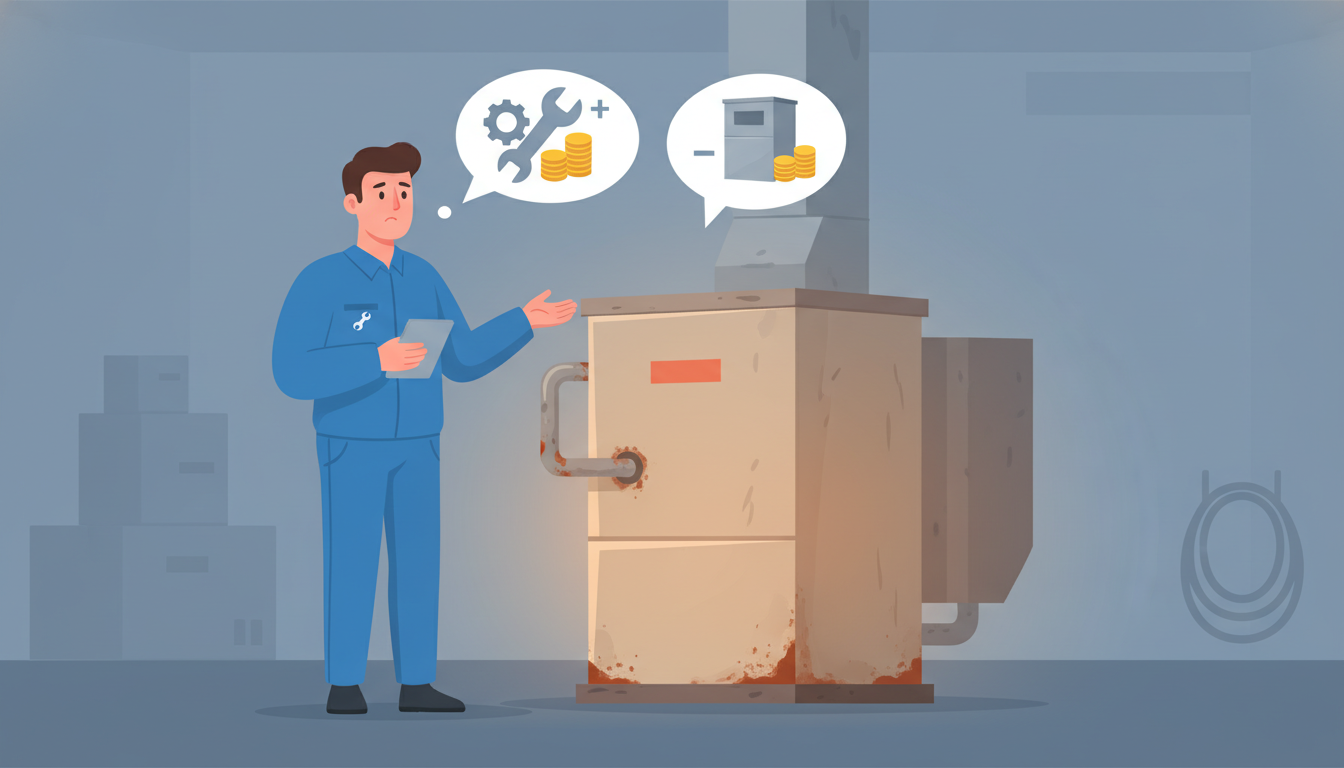
When your HVAC system breaks down, you face a critical question: should you repair it or replace it? While many factors influence this decision, equipment age is the single most important variable that changes the entire cost-benefit equation. A repair that makes perfect sense for a 5-year-old system could be a costly mistake for a 15-year-old unit.
Understanding how age affects your repair vs replace decision can save you thousands of dollars and prevent you from pouring money into a system that's living on borrowed time.
Why Equipment Age Matters More Than You Think
Your HVAC system doesn't fail all at once—it deteriorates gradually. As components age, they become less efficient, more prone to breakdowns, and increasingly expensive to maintain. The age of your equipment fundamentally changes three critical factors:
- Repair frequency increases exponentially after certain age thresholds
- Energy efficiency decreases by 1-2% annually due to normal wear
- Remaining service life determines whether repairs provide adequate return on investment
Think of it like an aging car. Replacing the transmission on a 3-year-old vehicle makes sense because you'll get years of reliable use. The same repair on a 15-year-old car with 200,000 miles? That's questionable economics.
Understanding HVAC System Lifespans
Before you can make an age-based decision, you need to know the typical lifespan for your specific equipment type. Different HVAC components have drastically different service lives.
Air Conditioners: 12-15 Years
Central air conditioning units typically last 12 to 15 years with proper maintenance. However, systems in hot climates or those that run continuously may reach end-of-life closer to the 10-year mark. If your AC is approaching this age range and needs significant repairs, replacement often provides better long-term value.
Furnaces: 15-20 Years
Gas and electric furnaces generally last 15 to 20 years, making them the longest-lived components in most HVAC systems. A well-maintained furnace in moderate climates can sometimes exceed 20 years. This longer lifespan means repairs on 10-year-old furnaces often make economic sense, while similar repairs on air conditioners of the same age might not.
Heat Pumps: 10-15 Years
Heat pumps work harder than standard air conditioners because they provide both heating and cooling. This dual-duty operation shortens their lifespan to 10 to 15 years. If your heat pump is over 10 years old and experiencing major component failures, you're likely in replacement territory.
Ductless Mini-Splits: 15-20 Years
Ductless systems often outlast traditional central air systems, with lifespans of 15 to 20 years. However, this depends heavily on proper sizing and professional installation.
The Age-Based Decision Framework
Here's where equipment age directly impacts your repair vs replace decision. Use these age-based guidelines to frame your thinking:
Equipment Under 5 Years Old: Almost Always Repair
If your system is less than 5 years old, repairs almost always make sense unless you're facing a catastrophic failure like a complete compressor burnout. At this age:
- Most components are still under manufacturer warranty
- The system has 70-80% of its service life remaining
- Energy efficiency is still close to new-equipment levels
- Proper repairs can restore the system to like-new performance
Exception: If you purchased a builder-grade economy system, even early failures might justify upgrading to better equipment.
Equipment 5-10 Years Old: Evaluate Repair Costs
This is the "middle age" for most HVAC equipment. The decision requires careful analysis:
- Warranties have typically expired
- The system has 40-60% of its service life remaining
- Minor repairs (under $500) usually make sense
- Major repairs require the $5,000 rule calculation (more on this below)
At this age, the type of repair matters significantly. Routine fixes like replacing a capacitor or fan motor are usually worthwhile. However, replacing a compressor or heat exchanger needs careful economic analysis.
Equipment 10-15 Years Old: Replacement Becomes Favorable
Once your system crosses the 10-year threshold, the economics shift dramatically toward replacement:
- The system is at or past its average lifespan (for AC and heat pumps)
- Energy efficiency has declined 10-20% from new
- Multiple components are approaching end-of-life simultaneously
- New systems offer 30-40% better efficiency than 10-year-old models
At this age, even moderate repairs ($800-$1,200) often fail the economic test. You're essentially investing in a depreciating asset with limited remaining service life.
Equipment Over 15 Years Old: Replace in Most Cases
If your HVAC system has passed 15 years, replacement is almost always the better choice, even for relatively minor repairs:
- The system is operating on borrowed time
- Any repair could be followed quickly by another failure
- Energy costs are significantly higher than modern equipment
- Parts may be difficult to source for older models
- You're missing out on modern comfort features and smart controls
The exception? A minor repair (under $300) that gets you through one more season while you plan and budget for replacement.
The $5,000 Rule: Age Meets Cost
The HVAC industry uses a simple calculation called the $5,000 rule to help homeowners make repair vs replace decisions. Here's how it works:
Multiply your system's age by the estimated repair cost. If the result exceeds $5,000, replace instead of repair.
Examples:
- 8-year-old system needing a $400 repair: 8 × $400 = $3,200 → Repair
- 12-year-old system needing a $600 repair: 12 × $600 = $7,200 → Replace
- 6-year-old system needing a $900 repair: 6 × $900 = $5,400 → Replace
- 10-year-old system needing a $450 repair: 10 × $450 = $4,500 → Repair (borderline)
This rule works because it automatically weights the decision more heavily toward replacement as equipment ages. A $700 repair might make sense at 6 years old but not at 14 years old.
How to Determine Your HVAC System's Age
Many homeowners don't know exactly how old their equipment is, especially if they purchased a previously owned home. Here's how to find out:
Step 1: Check the Manufacturer's Label
Look for a metal nameplate on your outdoor condenser unit and indoor furnace or air handler. This label contains:
- Manufacturer name
- Model number
- Serial number
- Sometimes a "MFR Date" (manufacturing date)
Step 2: Decode the Serial Number
Most manufacturers encode the manufacturing date directly into the serial number, though each brand uses different formats:
Trane: Since 2002, the serial number starts with a four-digit code. The first digit represents the year (9 = 2009, 0 = 2010, 1 = 2011, etc.).
Lennox: The serial number format is typically "5504A12345" where "55" is the plant code and "04" represents 2004.
Carrier/Bryant: Recent models use a four-digit code starting the serial number, with the first two digits representing the year.
Rheem/Ruud: The serial number often starts with a letter representing the month (A=January, B=February, etc.) followed by a two-digit year code.
Step 3: Use Online Decode Tools
If you're struggling to decode your serial number, visit BuildingCenter.org, which provides a free serial number decoder for most major HVAC brands.
Step 4: Check Installation Records
Look for paperwork from the original installation, home inspection reports, or contact your local HVAC company—they may have service records showing when the system was installed.
Repair Frequency Increases with Age
One of the most predictable patterns in HVAC equipment is that repair frequency accelerates as systems age. Understanding this pattern helps you recognize when you're entering the "money pit" phase.
The 3-Year Repair Frequency Rule
Track how many repairs your system has needed in the last three years:
- 0-1 repairs: Your system is in good health; continue with repairs as needed
- 2 repairs: Your system is showing age; evaluate each repair carefully
- 3+ repairs: Your system is deteriorating rapidly; replacement is usually more economical
This rule becomes even more important as equipment ages. A 7-year-old system needing its third repair in three years is a very different situation than a 14-year-old system with the same repair history.
Why Repairs Cluster at End of Life
HVAC systems experience a phenomenon called "cascade failure" where one component failure accelerates wear on related components:
- A failing compressor stresses the capacitor and contactors
- A restricted airflow from a dirty coil strains the blower motor
- Low refrigerant levels cause the compressor to work harder and overheat
Once cascade failures begin, you'll find yourself calling for repairs every few months. This is a clear signal that equipment age has made continued repairs economically unsound.
Age-Related Efficiency Decline
Equipment age doesn't just affect reliability—it dramatically impacts your energy costs. Understanding this decline helps quantify the hidden cost of keeping an aging system.
How Efficiency Decreases Over Time
Even with perfect maintenance, HVAC systems lose efficiency as they age:
- Years 1-5: Minimal efficiency loss (1-2%)
- Years 5-10: Moderate decline (5-10% total)
- Years 10-15: Significant decline (15-25% total)
- Years 15+: Severe efficiency loss (30%+ in many cases)
A system that cost $150/month to operate when new might cost $180-$200/month at 12 years old, even without any obvious problems.
The Efficiency Comparison
Modern HVAC equipment has dramatically improved over the past decade:
- 10-year-old AC: Typically SEER 10-13
- New standard AC: SEER 14-16 (required by law in most regions)
- High-efficiency new AC: SEER 18-22
Upgrading from a SEER 10 system to SEER 16 reduces energy consumption by approximately 38%. For a household spending $2,000 annually on cooling, that's $760 in savings every year.
When you factor age-related efficiency decline into your repair vs replace analysis, replacement often pays for itself through energy savings within 5-7 years.
Component-Specific Age Considerations
Not all HVAC components age at the same rate. When evaluating repairs, consider which component is failing and how its age compares to the overall system.
Compressor: The Most Critical Component
The compressor is the heart of your air conditioning or heat pump system. Compressor replacement costs $1,500-$3,000 and becomes increasingly risky as systems age:
- Under 7 years: Compressor replacement often makes sense
- 7-12 years: Borderline decision; use the $5,000 rule
- Over 12 years: Replacement rarely justified unless under warranty
If your compressor fails on a 10+ year-old system, this is nature's way of telling you it's time for a new system.
Blower Motor: Age Less Critical
Blower motor replacement costs $400-$800 and is less age-dependent because:
- Motors are standardized components available for decades
- The repair doesn't require refrigerant handling
- A new motor can function perfectly in an older system
Even on 15-year-old systems, blower motor replacement is often economical if the rest of the system is functioning well.
Refrigerant Leaks: Age Matters Significantly
The decision to repair refrigerant leaks depends heavily on both equipment age and refrigerant type:
R-22 (Freon) Systems: If your system uses R-22 refrigerant (phased out in 2020), it's almost certainly over 10 years old. R-22 prices have skyrocketed to $100-$150 per pound. Recharging an R-22 system is usually a stop-gap measure before replacement.
R-410A Systems: Newer systems using R-410A refrigerant are better candidates for leak repair, but only if the system is under 10 years old and the leak can be definitively located and repaired (not just recharged).
Heat Exchanger: Replace the Furnace
Heat exchanger failure in a furnace is a critical safety issue that produces carbon monoxide. Heat exchanger replacement costs $1,500-$3,500—often 60-80% of a new furnace cost.
Given this economics and safety considerations, heat exchanger failure is almost always a replacement decision unless:
- The furnace is under 8 years old AND under warranty
- The rest of the furnace is in excellent condition
- You're committed to staying in the home long-term
How Maintenance History Changes Age-Based Decisions
Two 12-year-old air conditioners aren't equivalent if one received annual professional maintenance while the other was neglected. Maintenance history can extend effective lifespan by 3-5 years.
Well-Maintained Systems: Add 20-30% to Expected Lifespan
If your system has received annual professional maintenance, you can afford to be more optimistic:
- Regular coil cleaning prevents efficiency loss
- Timely filter changes reduce blower motor strain
- Annual inspections catch small problems before they cascade
A well-maintained 13-year-old air conditioner might have the remaining service life of a neglected 10-year-old unit. This shifts the repair vs replace calculation slightly toward repair.
Neglected Systems: Subtract from Expected Lifespan
Conversely, if your system has been neglected, it's "older" than its chronological age:
- Dirty coils reduce efficiency and strain the compressor
- Skipped maintenance accelerates wear on all components
- Minor issues became major failures
If your 10-year-old system never received professional maintenance, treat it like a 12-13 year-old system in your decision-making.
Geographic and Climate Factors
Equipment age interacts with climate to affect replacement timing. Your location matters:
Hot Climates (Southwest, Southeast)
Air conditioners in Phoenix or Houston run 2-3 times longer annually than those in Seattle or Boston:
- Reduce expected lifespan by 15-20%
- Consider replacement at the lower end of age ranges
- A 12-year-old AC in Phoenix has worked as hard as a 18-year-old unit in Portland
Cold Climates (Northern States)
Furnaces and heat pumps experience intensive winter use:
- Furnaces may reach the lower end of their lifespan range
- Heat pumps in harsh climates face added strain from defrost cycles
- Consider climate when evaluating remaining service life
Moderate Climates (Coastal, Mild Regions)
Systems in mild climates can often exceed average lifespan expectations:
- Less extreme temperature operation reduces strain
- Equipment may provide reliable service 2-3 years beyond average lifespans
- Repairs on older equipment (13-16 years) may be justified
Special Considerations for Different Age Ranges
Brand New Systems (Under 1 Year)
If your new system experiences problems:
- Almost everything should be covered under warranty
- Repeated failures may indicate improper installation or defective equipment
- Document all issues for potential lemon law claims or warranty extensions
Don't assume you're stuck with problem equipment just because it's new. Chronic issues within the first year often signal fundamental problems.
Mid-Life Systems (5-10 Years)
This is the optimal range for evaluating individual repairs using a repair vs replace checklist:
- Start tracking repair costs annually
- Consider energy audits to quantify efficiency loss
- Begin researching replacement options so you're not making hasty decisions during a breakdown
Systems at Expected Lifespan (10-15 Years)
Once your system reaches its expected lifespan:
- Budget for replacement within 1-3 years
- Perform only essential repairs to maintain operation
- Don't invest in upgrades or efficiency improvements
- Start shopping for replacement systems to make informed decisions
Beyond Expected Lifespan (15+ Years)
If your system has exceeded its expected lifespan:
- Plan for emergency replacement—failure could happen anytime
- Keep contact information for 24/7 HVAC companies
- Consider replacing before failure during off-season for better pricing
- Don't sink money into major repairs—rent temporary equipment if needed while arranging replacement
Financial Considerations Beyond Age
While age is critical, integrate these financial factors into your decision:
Remaining Time in Your Home
If you're planning to sell within 1-2 years, the age-based decision changes:
- A functioning 14-year-old system may be adequate for selling the home
- Major repairs make less sense if you won't recoup the investment
- A new system adds selling value but may not pay for itself
- Focus on keeping the current system operational until sale
Conversely, if you're staying long-term (5+ years), replacement of aging systems becomes more attractive because you'll capture all the energy savings.
Available Incentives and Tax Credits
Federal tax credits and utility rebates can shift the economics significantly:
- High-efficiency systems may qualify for 30% federal tax credits (up to $2,000)
- Utility rebates can provide $300-$1,500 in additional savings
- Low-interest financing can make replacement affordable even without cash
A 12-year-old system needing a $1,200 repair becomes an easier replacement decision when $2,500 in incentives are available.
Energy Cost Trends
Rising energy costs increase the value of replacing aging, inefficient equipment:
- Calculate current operating costs
- Estimate 30-40% savings with new equipment
- Project energy cost increases over the next 5-10 years
In regions with high electricity costs, energy savings alone can justify replacing systems at the younger end of the age spectrum (10-12 years).
Red Flags: When Age Makes Replacement Urgent
Certain combinations of age and symptoms demand immediate replacement consideration:
- Age 10+ with refrigerant leaks: Older refrigerant systems rarely justify leak repair
- Age 12+ with compressor failure: The most expensive repair on an old system is almost never economical
- Age 15+ with any major repair: At this age, even moderate repairs are questionable
- Age 8+ with multiple repairs annually: Cascade failures indicate end-of-life regardless of age
- Age 10+ with 40%+ increase in energy costs: Severe efficiency decline signals imminent failure
Making Your Age-Based Decision
Follow this framework to integrate equipment age into your repair vs replace decision:
Step 1: Determine Exact Age
Use the serial number decoding methods outlined earlier to establish your system's precise age.
Step 2: Compare to Expected Lifespan
Calculate what percentage of expected lifespan your system has consumed:
- Under 50%: Lean toward repair
- 50-75%: Carefully evaluate repair costs
- 75-100%: Lean toward replacement
- Over 100%: Strong replacement candidate
Step 3: Apply the $5,000 Rule
Multiply age by repair cost. If over $5,000, replacement is usually better.
Step 4: Consider Repair Frequency
Systems needing 3+ repairs in three years are declining rapidly regardless of age.
Step 5: Calculate Energy Savings
Estimate monthly savings from a new, efficient system and calculate payback period.
Step 6: Evaluate Total Context
Consider your home plans, maintenance history, climate factors, and available incentives.
Frequently Asked Questions
Should I repair my 10-year-old air conditioner?
It depends on the repair cost and type. For minor repairs under $500, yes. For major component failures (compressor, coil replacement) costing over $1,000, replacement often provides better value. Apply the $5,000 rule: if repair cost × 10 exceeds $5,000, replace.
At what age should I automatically replace instead of repair?
There's no absolute cutoff, but systems over 15 years old should almost always be replaced rather than repaired, except for very minor fixes under $300. Systems 10-15 years old need careful economic analysis for any repair over $500.
How do I know if my HVAC system is too old?
Compare your system's age to these lifespans: AC units (12-15 years), furnaces (15-20 years), heat pumps (10-15 years). If your equipment is within or beyond these ranges, it's approaching end-of-life. Also watch for increasing repair frequency and rising energy bills.
Does a 20-year-old furnace need to be replaced?
While some furnaces can operate for 20+ years, a furnace this old is inefficient, prone to breakdowns, and potentially a safety hazard. Unless it requires only minor repairs and you're planning to replace within 1-2 years anyway, a 20-year-old furnace should be replaced.
Can regular maintenance extend my HVAC system's lifespan?
Yes, professional annual maintenance can extend equipment lifespan by 3-5 years. Well-maintained systems experience 30-50% fewer breakdowns and retain efficiency better than neglected equipment. However, maintenance can't overcome fundamental age-related wear—even perfect maintenance won't make a 17-year-old AC perform like a new one.
The Bottom Line on Age and Repair Decisions
Equipment age isn't just one factor in the repair vs replace decision—it's the factor that reframes all others. The same $800 repair represents a sound investment in a 6-year-old system but a questionable gamble on a 14-year-old unit.
Use age as your primary decision filter:
- Under 5 years: Repair unless catastrophic failure
- 5-10 years: Evaluate using the $5,000 rule
- 10-15 years: Lean toward replacement for major repairs
- Over 15 years: Replace in most scenarios
By understanding how equipment age changes the repair vs replace equation, you'll make informed decisions that save money, improve comfort, and avoid pouring resources into systems living on borrowed time.
When you're ready to make your decision, consult with a qualified HVAC professional who can assess your specific system's condition and provide detailed replacement estimates. Armed with the age-based framework in this guide, you'll be positioned to evaluate their recommendations critically and make the choice that's right for your home and budget.