Furnace Blowing Cold Air? Here's What Could Be Wrong
Furnace Blowing Cold Air? Here's What Could Be Wrong
Nothing's worse than turning on your furnace during a cold night, only to feel cold air blasting through your vents instead of warm, cozy heat. If your furnace is blowing cold air when the heat is on, don't panic—you're not alone, and the problem might be simpler than you think.
In this guide, we'll walk you through the most common reasons why your gas furnace is blowing cold air, help you troubleshoot the issue, and explain when you should call a professional for help. Many of these problems have quick DIY fixes, while others require expert attention to keep your heating system running safely.
Why Is My Furnace Blowing Cold Air? Common Causes
When your furnace blowing cold air but running normally, several issues could be to blame. Let's start with the simplest explanations and work our way up to more complex problems.
Your Furnace Just Started—Give It a Minute
Before you worry, understand that it's completely normal for your furnace to blow cool air for the first 30-90 seconds after startup. When your heating system first turns on, it needs to purge cold air that's been sitting in your ductwork since the last heating cycle.
This is called the "fan delay" period. Your blower motor kicks on before the burners fully heat the air, pushing out whatever air temperature is currently in the ducts. If warm air starts flowing after a minute or two, your furnace is working exactly as designed.
What to do: Wait 2-3 minutes. If the air remains cold after that, you've got a problem that needs attention.
Check Your Thermostat Settings First
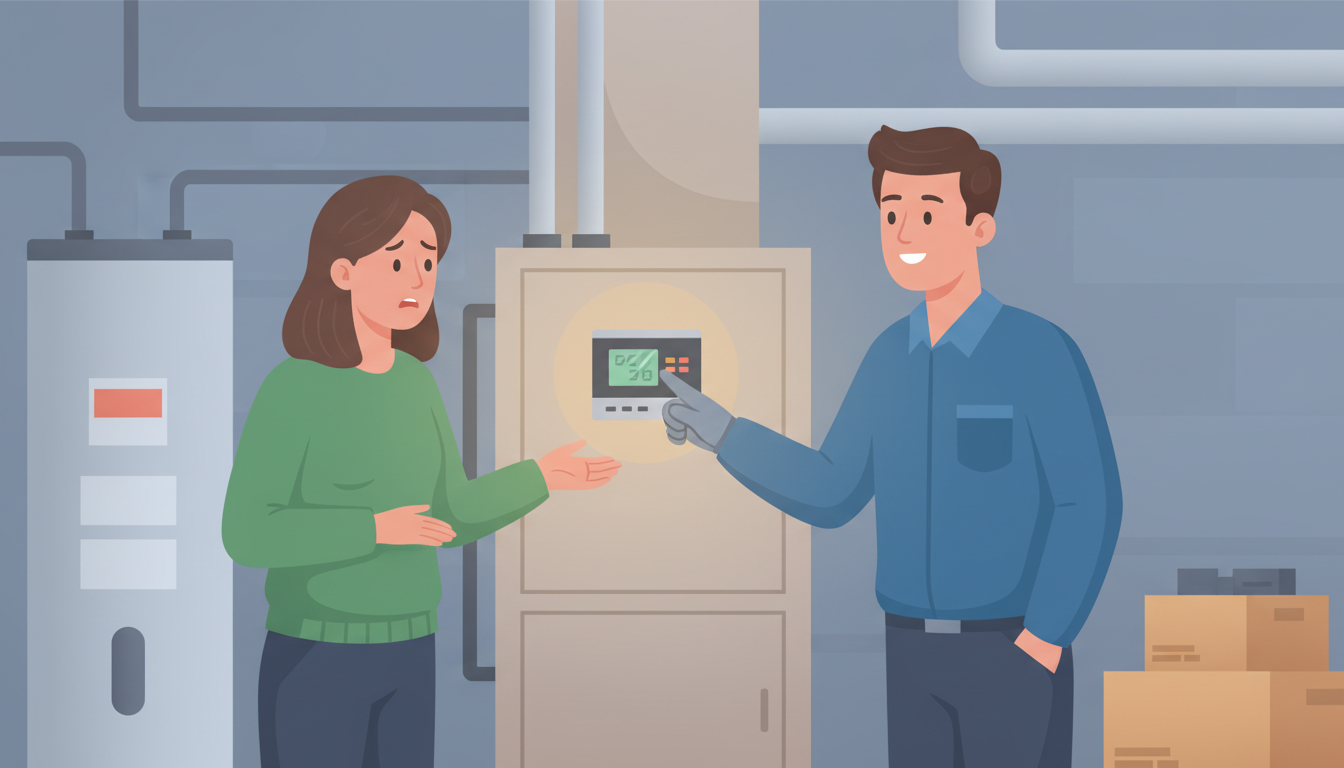
The most common reason for a furnace blowing cool air is actually a simple thermostat mistake. Before you do anything else, check these settings:
Fan Setting: If your thermostat fan is set to "ON" instead of "AUTO," your blower will run continuously—even when the furnace isn't actively heating. This means you'll feel cold air whenever the heating cycle isn't active.
- Solution: Switch your thermostat from "ON" to "AUTO." This tells the fan to run only when the furnace is actively producing heat.
Mode Setting: Make sure your thermostat is set to "HEAT" mode, not "COOL" or "OFF." It sounds obvious, but it's an easy mistake to make.
Temperature Setting: Verify that your desired temperature is actually higher than your current room temperature. If it's set lower, the furnace won't turn on at all.
Battery Check: Dead thermostat batteries can cause erratic behavior. Replace them if you haven't done so in the last year.
If you've recently had HVAC work done, someone might have accidentally changed these settings. A quick check can save you an unnecessary service call.
Your Air Filter Is Clogged
A dirty air filter is one of the most overlooked causes of furnace problems. When your filter gets clogged with dust, pet hair, and debris, it restricts airflow to your heating system. This creates a chain reaction of problems:
- Reduced airflow causes your heat exchanger to overheat
- The limit switch detects the excessive heat and shuts down the burners for safety
- The blower continues running (to cool the heat exchanger), but now it's only pushing cold air
How to check: Locate your air filter (usually in the return air vent or furnace cabinet). Hold it up to a light. If you can't see light through it, it's too dirty.
Solution: Replace disposable filters or clean permanent ones. Standard 1-inch filters should be changed every 30-90 days, depending on usage. If you have pets or allergies, change them monthly.
Cost: Filters cost $5-$25 each. This is the cheapest furnace maintenance you can do, and it prevents expensive repairs down the road.
Pilot Light or Ignition Problems
If you have an older gas furnace with a standing pilot light, it might have gone out. Without an active flame, your furnace can't heat air—it'll just blow cold air through your vents.
For older furnaces with pilot lights:
- Look for the pilot light assembly (check your owner's manual)
- See if there's a small blue flame burning
- If it's out, follow the manufacturer's instructions to safely relight it
- Make sure the area is well-ventilated and free of gas smell
For newer furnaces with electronic ignition: These don't have pilot lights. Instead, they use hot surface ignitors or spark ignitors. If you hear clicking sounds but no ignition, the ignitor might be failing.
When to call a pro: If your pilot won't stay lit after multiple attempts, or if you smell gas, turn off your furnace immediately and call an HVAC technician. Never try to force a gas furnace to work if you detect a gas odor.
For more detailed furnace troubleshooting, we've got a complete guide that walks through ignition issues step by step.
Dirty or Faulty Flame Sensor
Your furnace's flame sensor is a safety device that detects whether the burners have actually ignited. If the sensor is covered in soot or carbon buildup, it can't detect the flame—even when it's burning. The furnace will shut off the gas supply as a safety precaution, leaving you with just cold air.
Symptoms of a dirty flame sensor:
- Furnace starts, runs for a few seconds, then shuts off
- Burners light but extinguish almost immediately
- You hear the ignitor click repeatedly
DIY cleaning option: If you're handy, you can remove and clean the flame sensor with fine-grit sandpaper or steel wool. Turn off power to the furnace first, locate the sensor rod (a thin metallic rod near the burners), gently clean it, and reinstall.
Professional option: If you're not comfortable working with gas appliances, call a technician. A flame sensor cleaning typically costs $80-$150 as part of a service call.
Important: A failing flame sensor is a safety issue. Don't bypass safety mechanisms or run your furnace with a malfunctioning sensor.
Gas Supply Issues
Your gas furnace needs a steady supply of natural gas or propane to generate heat. If the gas supply is interrupted or restricted, your burners won't light—or won't stay lit—and you'll get cold air instead.
Possible causes:
- Gas valve is partially or fully closed
- Gas company service interruption in your area
- Propane tank is empty (for homes using propane)
- Gas line problems or leaks
What to check:
- Verify that the gas valve leading to your furnace is fully open (handle parallel to the pipe)
- Check if other gas appliances (stove, water heater) are working
- For propane users, check your tank gauge
When to call immediately: If you smell gas or suspect a gas leak, evacuate your home and call your gas company or 911. Don't try to locate the leak yourself or turn anything on or off.
Cost: Professional gas line repairs range from $150-$500 depending on the issue.
Blocked Condensate Drain Line
High-efficiency furnaces produce condensation as a byproduct of heating. This moisture drains away through a condensate line—but if that line gets clogged with algae, mold, or debris, the safety float switch triggers and shuts down your burners.
How to identify this issue:
- You notice water pooling around your furnace
- Your furnace runs briefly then shuts off
- You hear gurgling sounds near the furnace
DIY fix: You can try clearing the condensate line yourself:
- Locate the condensate drain line (usually a PVC pipe)
- Disconnect it and flush with hot water or a vinegar solution
- Use a wet/dry vacuum to suction out clogs
- Reconnect and test
Professional service: HVAC techs can clear stubborn clogs and treat the line to prevent future buildup. Cost: $100-$200.
Leaking or Damaged Ductwork
Even if your furnace is producing heat, you might feel cold air at the vents if your ductwork is leaking. According to Energy Star, homes can lose 20-30% of heated air through duct leaks, gaps, and poor connections.
Signs of duct problems:
- Some rooms are much colder than others
- You feel drafts near duct joints
- Higher-than-normal heating bills
- Dustier home than usual
Where leaks occur:
- Joints and connections between duct sections
- Areas where ducts pass through unconditioned spaces (attics, crawlspaces)
- Around supply and return vents
Solution: Duct sealing is best left to professionals who can use specialized equipment to find and seal leaks. Professional duct sealing costs $300-$1,500 but can reduce your heating costs by 20% or more.
DIY option: You can seal visible duct joints with mastic sealant or metal-backed tape (not regular duct tape, which deteriorates). Never use cloth duct tape for permanent repairs.
Blower Motor or Fan Limit Switch Problems
Your furnace's blower motor is responsible for pushing heated air through your ductwork. The fan limit switch controls when the blower turns on and off based on temperature.
Fan limit switch issues: If the limit switch is set incorrectly or malfunctioning, it might turn on the blower before the air is heated, or keep it running after the heating cycle ends.
Blower motor problems: A failing blower motor might run at reduced capacity, not run at all, or run constantly. You might hear unusual noises like squealing, grinding, or humming.
What you'll notice:
- Weak airflow from vents
- No airflow at all
- Constant airflow regardless of thermostat setting
- Strange mechanical noises
DIY check: Listen to your furnace during a heating cycle. The blower should start 30-60 seconds after the burners ignite and stop shortly after they turn off.
Professional diagnosis needed: Fan limit switches and blower motors require technical knowledge to diagnose and replace. Expect to pay $150-$500 for repairs depending on the component.
If you're experiencing furnace running but not heating issues, the blower motor or limit switch is often the culprit.
Circuit Control Board Failure
Modern furnaces use a circuit control board (like a computer motherboard) that manages all furnace functions. When the board receives a signal from your thermostat, it coordinates the ignition sequence, blower operation, and safety shutoffs.
If the control board malfunctions, it might:
- Turn on the blower without igniting the burners
- Fail to send signals to the gas valve
- Shut down prematurely due to false error codes
- Stop responding to thermostat commands entirely
Warning signs:
- Furnace won't start at all
- LED error codes flashing on the control board
- Intermittent operation with no pattern
- Furnace runs but doesn't complete heating cycles
Why boards fail:
- Power surges or electrical spikes
- Age and wear (typical lifespan: 10-20 years)
- Moisture damage
- Rodent damage to wiring
Professional repair required: Control board diagnosis and replacement requires specialized knowledge. A technician will test the board, check for error codes, and verify that the problem isn't elsewhere in the system. Replacement costs $200-$600 including labor.
Quick Troubleshooting Checklist
Before you call for professional help, run through this quick checklist:
- ✅ Wait 2-3 minutes after startup to see if warm air begins flowing
- ✅ Check thermostat settings: Fan on AUTO, Mode on HEAT, temperature set above room temp
- ✅ Replace or clean air filter if it's dirty or clogged
- ✅ Verify gas supply: Gas valve open, other gas appliances working
- ✅ Look for error codes flashing on your furnace control board
- ✅ Listen for unusual sounds: clicking, squealing, or banging noises
- ✅ Check circuit breaker to ensure furnace has power
If none of these solve the problem, it's time to call a qualified HVAC technician.
When to Call a Professional vs. DIY
Some furnace repairs are simple enough for homeowners to handle, while others require professional expertise—and attempting DIY repairs on complex issues can be dangerous.
Safe DIY Fixes:
- Changing air filters
- Adjusting thermostat settings
- Relighting a pilot light (if you're comfortable and follow instructions carefully)
- Cleaning condensate drain lines
- Replacing thermostat batteries
Call a Professional For:
- Gas leaks or strong gas odors (call immediately!)
- Flame sensor cleaning (unless you're very comfortable with gas appliances)
- Control board diagnosis and replacement
- Blower motor repairs
- Gas valve repairs
- Electrical issues
- Any problem you're not 100% confident handling
Safety first: Never attempt repairs on gas furnaces if you're uncertain. Gas leaks and carbon monoxide are serious hazards. When in doubt, call a licensed HVAC technician.
Warranty considerations: If your furnace is still under warranty, DIY repairs might void your coverage. Check your warranty terms before attempting any fixes beyond basic maintenance.
How Much Do Furnace Repairs Cost?
Understanding typical repair costs helps you budget and make informed decisions:
- Thermostat replacement: $100-$300
- Air filter (DIY): $5-$25
- Flame sensor cleaning: $80-$150
- Ignitor replacement: $150-$300
- Blower motor replacement: $300-$600
- Gas valve replacement: $300-$750
- Control board replacement: $200-$600
- Full ductwork sealing: $300-$1,500
When to consider replacement: If your furnace is over 15-20 years old and needs major repairs costing more than half the price of a new unit, replacement might be more cost-effective than repair.
Frequently Asked Questions
Why is my furnace blowing lukewarm air instead of hot air?
Lukewarm air usually indicates your furnace is working but not at full capacity. Common causes include a partially clogged air filter restricting airflow, a failing blower motor running at reduced speed, or leaky ductwork losing heat before reaching your vents. Start by replacing your air filter and checking for visible duct leaks.
Can a dirty filter cause my furnace to blow cold air?
Yes, absolutely. A clogged air filter is one of the most common causes of furnaces blowing cold air. When the filter restricts airflow, the heat exchanger overheats and triggers the limit switch, which shuts down the burners for safety. The blower continues running to cool the system, pushing cold air through your vents.
Why does my furnace blow cold air after I just changed the filter?
If your furnace blows cold air immediately after a filter change, you might have installed the filter backwards (check the airflow arrow), chosen a filter with too high a MERV rating (restricting airflow), or accidentally bumped a wire or switch while changing the filter. Verify the filter direction and ensure it fits properly in the housing.
Is it dangerous if my furnace is blowing cold air?
Cold air itself isn't dangerous, but the underlying cause might be. A malfunctioning flame sensor, cracked heat exchanger, or gas supply problem could pose safety risks. If you smell gas, notice unusual odors, or see visible cracks in components, turn off your furnace and call a professional immediately.
How long should I wait before calling for help?
If basic troubleshooting (thermostat check, filter replacement) doesn't restore heat within an hour, and your home temperature is dropping uncomfortably, call for professional help—especially during severe cold weather. Most HVAC companies offer emergency service for situations where you're without heat.
Conclusion: Get Your Heat Back Fast
A furnace blowing cold air is frustrating, but it's often fixable with simple troubleshooting. Start with the easiest solutions—check your thermostat settings, replace your air filter, and verify your gas supply. Many homeowners solve the problem in minutes without spending a dime.
For more complex issues involving flame sensors, control boards, or blower motors, professional help is your safest bet. A qualified HVAC technician has the tools, expertise, and safety training to diagnose and fix your furnace quickly.
Don't let a cold house ruin your winter. Whether you tackle it yourself or call in the pros, addressing the problem quickly prevents further damage and keeps your family comfortable all season long.
Need professional help? A licensed HVAC technician can diagnose and repair your furnace safely, often the same day you call. Regular maintenance prevents most of these issues from happening in the first place—schedule annual furnace inspections to keep your heating system running efficiently for years to come.