How Power Surges Affect HVAC Systems: What Every Homeowner Needs to Know
How Power Surges Affect HVAC Systems: What Every Homeowner Needs to Know
Have you ever wondered what happens to your air conditioner or furnace during a thunderstorm? When lightning strikes or the electrical grid fluctuates, your HVAC system faces a serious threat that could leave you without heating or cooling when you need it most. Power surges can instantly damage expensive components in your HVAC equipment, leading to costly repairs or complete system replacement.
Understanding how power surges affect HVAC systems is essential for protecting your home comfort investment. In this guide, you'''ll learn exactly what happens during a surge, which parts are most vulnerable, and how to prevent thousands of dollars in damage.
What Is a Power Surge and How Does It Happen?
A power surge is a sudden spike in electrical voltage that exceeds the standard 120 volts delivered to your home. These voltage spikes last only milliseconds but can reach thousands of volts, overwhelming your HVAC system'''s sensitive electronics.
Power surges occur for several reasons:
- Lightning strikes - When lightning hits power lines or near your property, it sends massive voltage through your electrical system. Lightning causes about 30% of all power surges in the United States.
- Electrical grid switching - When your utility company switches power grids or restores power after an outage, it can create voltage fluctuations.
- Downed power lines - Damaged lines from storms or accidents cause irregular power delivery.
- Large appliances cycling - When high-demand equipment like your air conditioner compressor turns on or off, it can create small surges throughout your home'''s wiring.
- Faulty wiring - Old or damaged electrical systems can generate internal surges.
While lightning gets most of the attention, smaller daily surges from appliances and grid fluctuations actually cause more cumulative damage over time. These mini-surges slowly degrade your HVAC components until they fail.
How Power Surges Affect HVAC Systems
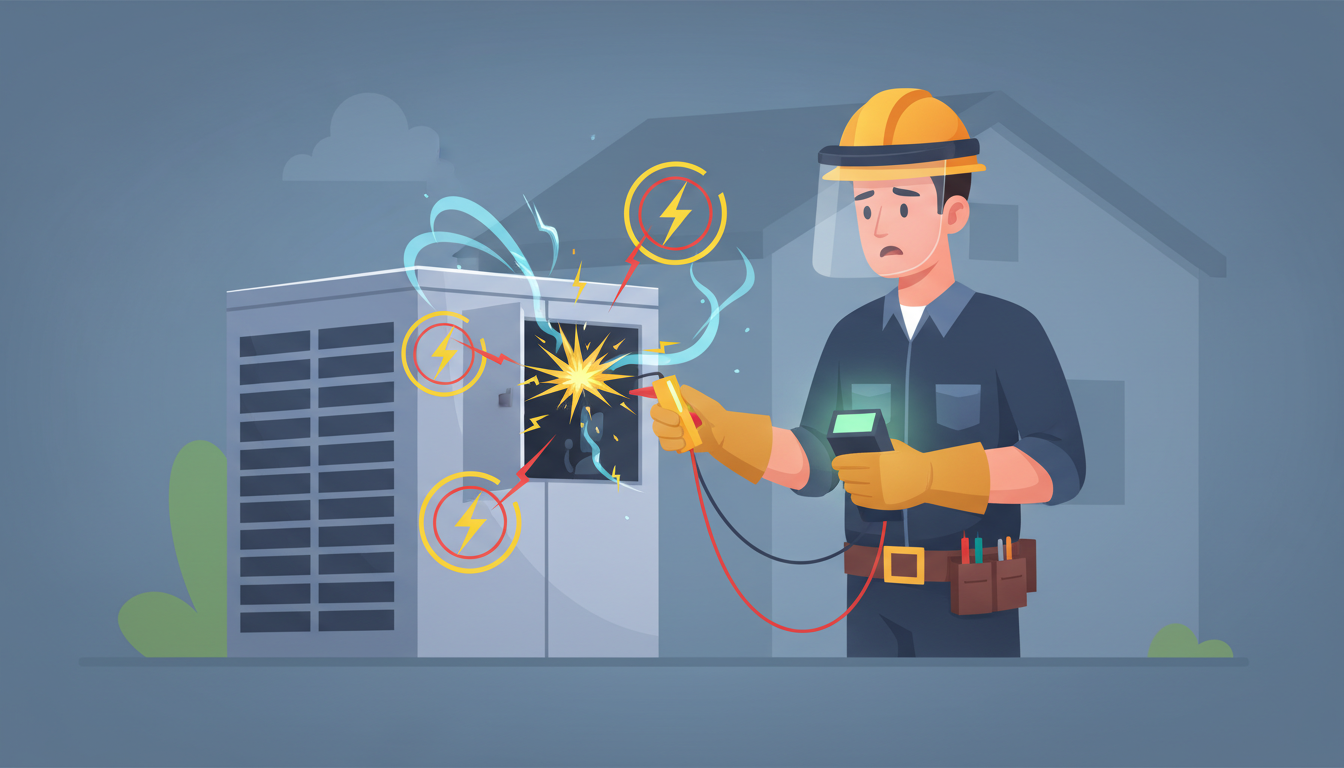
Your HVAC system contains sophisticated electronic controls and motors that operate within specific voltage ranges. When a power surge hits, the excess electrical energy overwhelms these components, causing immediate or progressive damage.
Modern HVAC systems are particularly vulnerable because they rely on circuit boards, sensors, and computerized controls. Older mechanical systems had fewer electronics, but today'''s energy-efficient equipment depends heavily on sensitive technology that power surges can destroy in an instant.
The damage happens in three ways:
- Instant destruction - High-voltage surges burn through wiring, melt circuit traces, and blow capacitors immediately.
- Heat damage - Excess current generates extreme heat in motor windings and electronic components, causing thermal failure.
- Degradation - Repeated small surges weaken insulation, corrode connections, and stress components until they fail prematurely.
HVAC Components Most Vulnerable to Power Surge Damage
Not all parts of your HVAC system are equally at risk. Understanding which components are most vulnerable helps you recognize surge damage and prioritize protection.
Control Board
The control board is your HVAC system'''s brain, coordinating all operations and communicating with your thermostat. Power surges can fry circuit traces and microchips on this board, rendering your entire system inoperable.
When your control board fails, your HVAC won'''t respond to thermostat commands, and you'''ll see error codes or complete system shutdown. Replacing a control board typically costs $300-$600 including labor, though some high-end systems can exceed $1,000.
Compressor Motor
Your air conditioner'''s compressor is one of the most expensive components and highly susceptible to surge damage. The electrical energy from a surge heats the motor'''s copper windings, melting the insulation and creating short circuits.
A damaged compressor motor won'''t function properly, causing your AC to blow warm air or fail to start. Compressor replacement is the most expensive surge-related repair, typically ranging from $1,200 to $2,500 or more depending on your system size and refrigerant type. In many cases, replacing the entire outdoor unit makes more financial sense than replacing just the compressor.
Capacitor
Capacitors store electrical energy to help motors start and run efficiently. They'''re designed to handle specific voltage levels, and surges can cause them to blow instantly. A blown capacitor is one of the most common surge-related failures.
Signs of capacitor failure include:
- HVAC system humming but not starting
- Hard starting (takes multiple attempts to turn on)
- Short cycling (turning on and off frequently)
- Complete failure to operate
Fortunately, capacitor replacement is relatively affordable at $150-$400, making it one of the less painful surge damage repairs. However, if you need HVAC repair guidance, it'''s important to address capacitor issues quickly before they cause secondary damage to motors.
Relay Switches
Relay switches act as electrical gatekeepers, opening and closing circuits to control different HVAC functions. When voltage becomes too high, it burns the relay coil, preventing proper circuit completion.
Failed relays cause intermittent operation, where your system works sometimes but not others. You might notice your fan running but no cooling, or heating that stops and starts randomly.
Thermostat
While your thermostat sits inside your home away from the outdoor unit, it'''s still vulnerable to power surges traveling through low-voltage wiring. Modern smart thermostats contain circuit boards that can be destroyed by voltage spikes.
A surge-damaged thermostat might display error messages, lose its programming, fail to control your HVAC system, or stop working entirely. Replacement costs vary from $150 for basic models to $500+ for smart thermostats with professional installation.
Condenser Fan Motor
The outdoor condenser fan motor circulates air over your AC'''s coils to dissipate heat. Power surges can damage the motor windings or its run capacitor, causing the fan to stop spinning.
Without proper airflow, your AC will overheat and shut down. You might notice your outdoor unit making noise but the fan not spinning, or the system running very briefly before tripping a breaker. If your HVAC breaker keeps tripping, surge damage to the fan motor could be the culprit.
Warning Signs Your HVAC System Suffered Power Surge Damage
After a storm or power outage, watch for these telltale signs that your HVAC system experienced surge damage:
System won'''t turn on at all - Complete failure to start after a power event strongly suggests surge damage to the control board, capacitor, or multiple components.
Strange noises - Clicking, buzzing, or humming sounds without normal operation indicate electrical component failure. A buzzing compressor that won'''t start often means capacitor damage.
Burning smell - A burnt electrical odor signals damaged wiring, fried circuit boards, or blown capacitors. Turn off your system immediately if you smell burning.
Breaker keeps tripping - Repeated breaker trips after a power surge suggest short circuits in motors, compressors, or wiring damaged by excess voltage.
Thermostat malfunction - If your thermostat display is blank, shows error codes, or fails to control your HVAC after a power event, it may have sustained surge damage.
Reduced performance - Weak airflow, inadequate heating or cooling, or inconsistent operation can indicate partial damage to motors or controls.
Higher electricity bills - Surge-damaged components often work inefficiently, drawing more power than normal and increasing your energy costs.
If you notice any of these symptoms after a storm or power outage, call an HVAC technician immediately. Continuing to operate a surge-damaged system can cause additional failures and increase repair costs.
The True Cost of Power Surge Damage to Your HVAC
Power surge damage goes beyond immediate repair costs. Understanding the full financial impact helps you appreciate why prevention matters.
Direct repair costs vary by component:
- Capacitor replacement: $150-$400
- Control board replacement: $300-$600
- Thermostat replacement: $150-$500
- Relay switch repair: $200-$400
- Compressor replacement: $1,200-$2,500
- Complete system replacement: $5,000-$12,000+
Indirect costs add up quickly:
- Emergency service call fees ($100-$300 for after-hours service)
- Temporary lodging if your home becomes uninhabitable during extreme weather
- Spoiled food from extended cooling loss
- Lost productivity working from home without climate control
- Increased insurance premiums after claims
Warranty complications create additional problems. Most HVAC manufacturers explicitly exclude power surge damage from warranty coverage, meaning you'''ll pay full price for repairs even on new equipment. Some homeowners''' insurance policies cover surge damage, but deductibles and rate increases may make claims financially unattractive.
How to Protect Your HVAC System from Power Surges
Prevention is far more cost-effective than repair. Implementing proper surge protection safeguards your HVAC investment and prevents emergency breakdowns.
Install a Whole-House Surge Protector
A whole-house surge protector mounts at your main electrical panel and defends all appliances and electronics from surges entering through power lines. These devices can block 60-80% of the most common residential power surges.
Professional installation costs $300-$600, and the device protects your entire home—not just your HVAC but also computers, appliances, and entertainment systems. This is the single most effective protection method.
Add Dedicated HVAC Surge Protection
For extra protection, install a point-of-use surge protector specifically designed for HVAC equipment at your outdoor disconnect box. These devices provide a second layer of defense directly at your air conditioner or heat pump.
HVAC-specific surge protectors cost $100-$300 installed and are especially valuable if you'''ve already invested in whole-house protection but want redundancy for your most expensive appliance.
Turn Off Your System During Severe Storms
When thunderstorms approach, manually turn off your HVAC system at the thermostat and disconnect box. This simple step eliminates the pathway for lightning-induced surges to reach your equipment.
While not always practical (you can'''t always be home or know when storms are coming), this zero-cost method provides 100% protection when you can implement it.
Maintain Proper Electrical Grounding
Proper grounding gives excess electrical energy a safe path to earth instead of through your HVAC components. Have a licensed electrician verify that your home'''s grounding system meets current code requirements.
Older homes often have inadequate grounding that increases surge damage risk. Upgrading your grounding system typically costs $500-$1,500 but protects all electrical equipment.
Schedule Regular HVAC Maintenance
Professional maintenance helps technicians identify surge damage before it causes complete failure. During tune-ups, technicians test electrical components, measure voltage, and catch early warning signs of stress from small surges.
Annual maintenance costs $100-$200 but extends equipment life, improves efficiency, and prevents emergency breakdowns. Think of it as insurance that pays dividends in reliability.
Consider Upgrading to Surge-Resistant Equipment
When replacing old HVAC equipment, look for systems with built-in surge protection features. Some manufacturers incorporate surge-resistant components and enhanced electrical shielding.
While these systems cost more upfront, they offer better protection in surge-prone areas and may reduce long-term repair costs.
Review Your Insurance Coverage
Check whether your homeowner'''s insurance covers power surge damage to HVAC equipment. Some policies include this coverage, while others require riders or exclude it entirely.
If coverage is available, document your HVAC system'''s age and condition with photos and maintenance records. This documentation streamlines claims after surge damage occurs.
What to Do Immediately After a Power Surge
If your area experiences a lightning strike, major power outage, or obvious electrical event, take these steps to protect your HVAC system:
-
Turn off your HVAC immediately - Don'''t restart the system until you'''ve confirmed it'''s safe to do so.
-
Check your electrical panel - Look for tripped breakers or blown fuses. Reset breakers once, but if they trip again, call an electrician before investigating further.
-
Inspect your thermostat - Verify it'''s displaying properly and responding to inputs. Try changing the temperature setting to see if it communicates with your HVAC.
-
Look for visible damage - At your outdoor unit, check for burnt wires, melted plastic, or damaged components. Don'''t open electrical panels yourself.
-
Listen for unusual sounds - When you first restart your system (if breakers are good), listen for clicking, buzzing, or grinding noises that weren'''t present before.
-
Call a professional - Even if your system seems to work, have a technician inspect it after significant power events. Hidden damage can worsen over time.
-
Document everything - Take photos, save receipts, and record the date and circumstances for insurance purposes.
Attempting DIY electrical HVAC repairs is risky and can void warranties or cause additional damage. Power surge diagnosis requires specialized tools and expertise.
FAQ About Power Surges and HVAC Systems
Can a power surge damage my HVAC even if it'''s turned off?
Yes. If your HVAC is connected to power at the breaker, surges can still damage components even when the thermostat is off. Only physically disconnecting power at the outdoor disconnect box provides complete protection.
Will my HVAC warranty cover power surge damage?
No. Most HVAC manufacturers explicitly exclude power surge damage from warranty coverage, considering it environmental damage beyond their control. Check your specific warranty terms and homeowner'''s insurance policy instead.
How do I know if a power surge damaged my HVAC or if it'''s a different problem?
Timing is the key indicator. If your HVAC was working fine before a storm, power outage, or electrical event but fails immediately afterward, surge damage is likely. A technician can use diagnostic tools to confirm surge-related component failures.
Are mini-split systems less vulnerable to power surges than central HVAC?
Not necessarily. Mini-splits contain the same vulnerable components (compressor, control boards, capacitors) and face similar surge risks. However, their outdoor units are often smaller with less expensive compressors, potentially reducing repair costs.
How often should I replace my surge protector?
Whole-house surge protectors don'''t last forever. Each surge they block degrades their protection capacity. Most manufacturers recommend replacement every 5-10 years, or immediately after a major lightning strike near your home. Many models have indicator lights showing when they need replacement.
Conclusion: Protecting Your HVAC Investment from Power Surges
Power surges pose a serious threat to your HVAC system'''s expensive components, from control boards to compressors. A single lightning strike or major voltage spike can cause thousands of dollars in damage, leaving you without climate control when you need it most.
The good news is that protection is straightforward and affordable. Installing a whole-house surge protector for $300-$600 shields your entire electrical system, including your HVAC. Combined with dedicated HVAC surge protection, proper grounding, and regular maintenance, you can dramatically reduce your risk of surge-related failures.
Don'''t wait until after storm damage to take action. The cost of prevention is a fraction of the price of compressor replacement or system failure. If your area is prone to thunderstorms or experiences frequent power fluctuations, surge protection isn'''t optional—it'''s essential maintenance.
Has your HVAC system experienced power surge damage? Schedule a professional inspection to assess your equipment'''s condition and discuss protection options. Your comfort and your wallet will thank you when the next storm rolls through.