
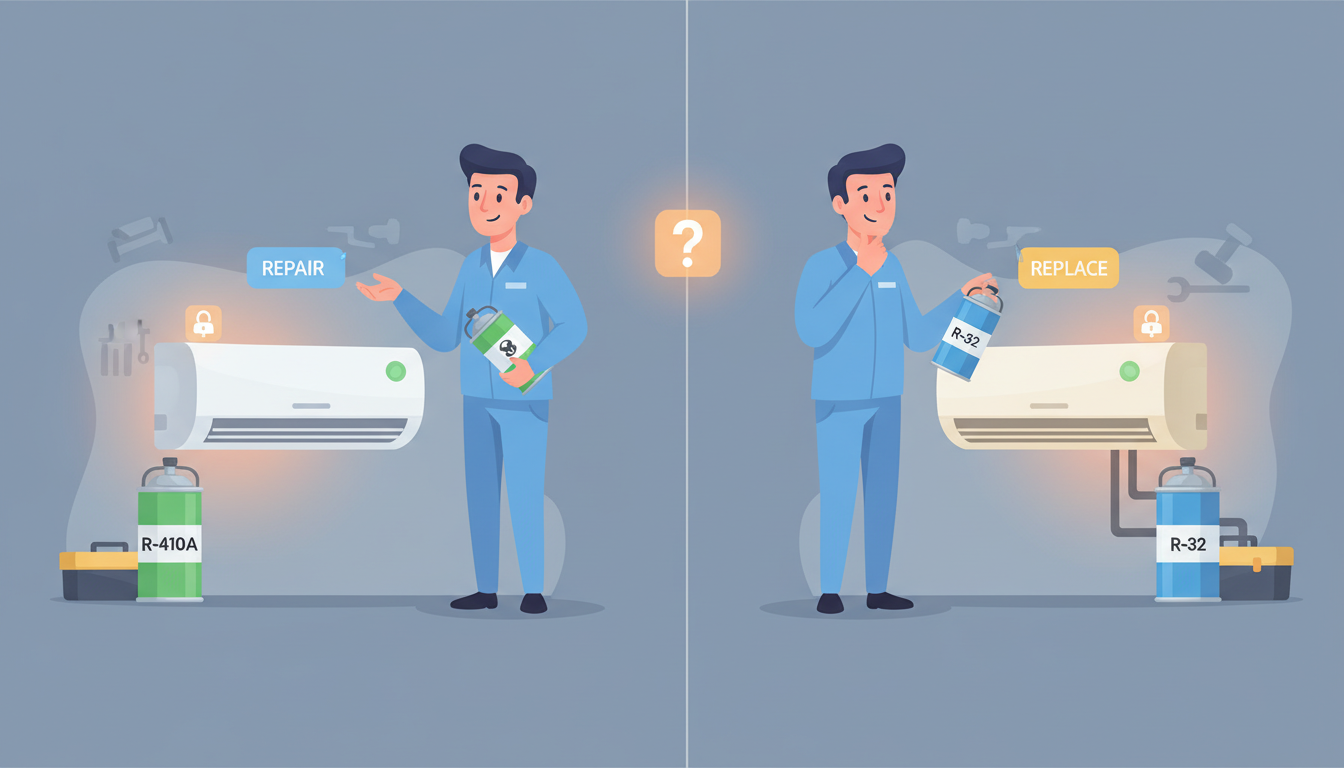
How Refrigerant Type Affects Your Repair vs Replace Decision
How Refrigerant Type Affects Your Repair vs Replace Decision
Is your air conditioner showing signs of trouble? Before you call a technician, there's one critical factor that could determine whether you're looking at a simple repair or a complete system replacement: the type of refrigerant your AC uses.
The refrigerant in your HVAC system isn't just a minor detail. It can be the difference between a $200 repair and a $5,000+ replacement. With recent EPA regulations phasing out older refrigerants and new environmental standards coming into effect, understanding how refrigerant type affects repair vs replace decisions has never been more important for homeowners.
Understanding the Three Major Refrigerants in Your Home
Your air conditioning system uses one of three primary refrigerants, and each one comes with different implications for repairs, costs, and longevity.
R-22 (Freon): The Phased-Out Refrigerant
R-22, commonly known by the brand name Freon, was the standard refrigerant in air conditioners installed before 2010. This chlorofluorocarbon (CFC) was incredibly effective at cooling but came with a significant environmental drawback: it depletes the ozone layer.
As of January 1, 2020, the EPA banned all production and import of R-22 refrigerant in the United States. While it's still legal to use R-22 in existing systems, the available supply comes only from recycled or reclaimed sources. This scarcity has created a perfect storm for homeowners with older AC units.
R-410A (Puron): The Current Standard
R-410A, marketed under the brand name Puron, became the industry standard replacement for R-22. This hydrofluorocarbon (HFC) doesn't deplete the ozone layer and operates at higher pressures, making it more efficient for cooling.
Most air conditioners installed between 2010 and 2025 use R-410A. However, this refrigerant is also facing regulatory changes. New residential air conditioners using R-410A cannot be manufactured after January 1, 2025, though existing systems can continue operating and can still be serviced.
R-454B: The Next Generation
R-454B represents the future of HVAC refrigerants. With a significantly lower global warming potential (GWP) than R-410A, this next-generation refrigerant meets new environmental standards while maintaining excellent cooling performance.
If you're replacing your system in 2025 or beyond, you'll likely receive an R-454B system. Understanding this transition is crucial when making repair vs replace decisions for your current unit.
How Refrigerant Type Dramatically Affects Repair Costs
The type of refrigerant in your system creates vastly different cost scenarios when repairs are needed. Here's what you need to know about refrigerant leak symptoms and repair costs.
R-22 Repair Costs: When Fixing Becomes Unaffordable
The scarcity of R-22 has created astronomical repair costs. In 2026, R-22 refrigerant costs between $100-$180 per pound, with most residential systems requiring 6-15 pounds for a full recharge. That means a simple refrigerant recharge can cost $1,500-$2,000 or more.
Consider these R-22 repair scenarios:
- Minor leak repair + recharge: $800-$2,500
- Compressor replacement: $2,500-$4,000
- Evaporator coil replacement: $1,800-$3,500
When you factor in labor costs and the reality that R-22 prices continue climbing, many repairs approach or exceed 50% of a new system's cost.
R-410A Repair Costs: More Reasonable, But Still Declining
R-410A refrigerant remains relatively affordable at $20-$40 per pound, making repairs more economical. However, smart homeowners should consider the 2025 manufacturing cutoff.
Typical R-410A repair costs:
- Refrigerant recharge: $300-$800
- Compressor replacement: $1,500-$3,000
- Evaporator coil replacement: $1,200-$2,500
While these costs seem more manageable, you're investing in a system using refrigerant that will eventually face the same scarcity issues as R-22.
R-454B Systems: Future-Proof Investment
New systems using R-454B come with full warranties, readily available parts, and a refrigerant that will remain in production for decades. The long-term total cost of ownership favors these modern systems significantly.
The Compatibility Problem: Why You Can't Just Switch Refrigerants
One of the most common homeowner questions is: "Can I just replace R-22 with R-410A in my existing system?" The short answer is no, and understanding why is crucial for making informed decisions.
Why Refrigerants Aren't Interchangeable
R-22 and R-410A operate at completely different pressures. R-410A runs at approximately 60% higher pressure than R-22. If you simply added R-410A to an R-22 system, the increased pressure would likely rupture components, causing catastrophic system failure.
Each refrigerant also requires different lubricating oils. R-22 uses mineral oil, while R-410A requires synthetic polyol ester (POE) oil. Mixing these oils can damage your compressor and reduce system efficiency.
The Retrofit Myth: Why Conversion Rarely Makes Sense
Some companies offer "retrofit" services to convert R-22 systems to accept R-410A. While technically possible, this approach typically requires:
- Complete compressor replacement
- New condenser unit
- New evaporator coil
- New refrigerant lines
- Complete system flush
- New expansion valve or metering device
By the time you've replaced all these components, you've essentially paid for a new system while keeping an old cabinet and some aging ductwork. The labor costs alone make this approach financially questionable.
Most HVAC professionals agree: if your R-22 system needs major repairs, complete replacement makes more sense than retrofit conversion.
Decision Framework: When Refrigerant Type Says "Replace"
Understanding your refrigerant type helps create a clear decision framework. Here's when the type of refrigerant strongly indicates replacement is your best option.
R-22 Systems: Replace If...
Your R-22 air conditioner is a strong candidate for replacement when:
The system is 10+ years old: Most AC units last 12-15 years. If your R-22 system is already approaching this age, investing in expensive repairs doesn't make financial sense.
You need more than 3 pounds of refrigerant: With R-22 costing $100-$180 per pound, recharging becomes incredibly expensive. A significant leak requiring substantial refrigerant is often a sign of bigger problems.
The compressor has failed: Compressor replacement in an R-22 system can cost $3,000-$4,000. For comparison, a complete new system with R-454B refrigerant starts around $4,500-$6,000 with warranty coverage and improved efficiency.
You're experiencing frequent repairs: If you've needed multiple service calls in the past two years, your system is telling you it's nearing end of life. Continuing to repair an R-22 system means paying premium prices for increasingly scarce parts.
Energy bills are climbing: R-22 systems typically have SEER ratings between 8-13. Modern systems achieve SEER 15-20+, potentially cutting your cooling costs by 30-50%.
For comprehensive guidance on making this decision, check out our HVAC repair guide.
R-410A Systems: Consider Replacement If...
R-410A systems fall into a gray area. They're not as urgent to replace as R-22 systems, but the 2025 manufacturing cutoff creates important considerations:
The system is 12+ years old: You're approaching typical system lifespan, and parts may become harder to source as manufacturers shift to R-454B.
Major component failure occurs: If your compressor, condenser, or evaporator fails, you're investing $1,500-$3,000 into refrigerant technology that's being phased out.
SEER rating is below 14: Older R-410A systems may not meet modern efficiency standards. Upgrading can significantly reduce energy costs.
You're planning to sell your home within 5 years: A new, efficient system with R-454B can be a strong selling point and may prevent negotiation issues during home inspections.
Repair costs exceed 50% of replacement cost: This is the traditional HVAC rule of thumb, and it remains sound advice.
When Repair Still Makes Sense
Even with older refrigerants, repair can be the right choice in specific situations:
R-410A systems under 7 years old: These systems likely have years of reliable service remaining, and parts are still readily available.
Minor repairs under $500: Simple fixes like capacitor replacement, thermostat issues, or fan motor repairs make sense regardless of refrigerant type.
Well-maintained systems with no history of problems: A single issue on an otherwise healthy system doesn't necessarily indicate replacement is needed.
Financial constraints: If replacement isn't immediately affordable, a strategic repair can buy time while you plan and budget for system replacement.
For detailed analysis of repair vs replacement scenarios, read our guide on refrigerant leak repair vs system replacement.
The Environmental and Legal Considerations
Refrigerant type isn't just about costs—it's also about environmental responsibility and legal compliance.
EPA Regulations You Need to Know
The EPA's refrigerant phase-out follows the Montreal Protocol, an international treaty designed to protect the ozone layer. Here's what homeowners need to understand:
R-22 restrictions: While you can legally continue using your R-22 system, any refrigerant must come from recycled or reclaimed sources. Proper disposal is required when the system is finally replaced.
Technician certification: Only EPA-certified technicians can handle refrigerants. DIY refrigerant recharging is illegal and can result in fines up to $37,500 per violation.
Venting prohibitions: It's illegal to deliberately vent refrigerants into the atmosphere. Technicians must recover and properly recycle refrigerants when servicing systems.
Environmental Impact of Your Choice
Modern refrigerants like R-454B have significantly lower environmental impact:
Global Warming Potential (GWP):
- R-22: GWP of 1,810
- R-410A: GWP of 2,088
- R-454B: GWP of 466
Choosing to replace an older system with modern technology doesn't just save you money—it reduces your environmental footprint by roughly 75-80%.
How to Identify Which Refrigerant Your System Uses
Not sure what refrigerant your AC uses? Here's how to find out:
Check the Equipment Label
Look for a data plate or label on your outdoor condenser unit. It will clearly state the refrigerant type. Common labels include:
- "R-22" or "HCFC-22" or "Freon"
- "R-410A" or "HFC-410A" or "Puron"
- "R-454B"
Check the Installation Date
If you can't find the label, the installation date provides strong clues:
- Before 2010: Almost certainly R-22
- 2010-2024: Likely R-410A
- 2025 or later: Probably R-454B
Look at the Color Coding
While not always reliable, refrigerant tanks use color coding:
- R-22: Green tank
- R-410A: Rose/pink tank
- R-454B: Purple tank
Ask Your HVAC Technician
During your next maintenance visit, ask your technician to confirm your refrigerant type and document it for your records.
The True Cost of Ownership: Beyond Initial Repair Prices
When evaluating repair vs replace decisions based on refrigerant type, consider the total cost of ownership over 5-10 years.
R-22 System: The Declining Value Proposition
Let's examine a 12-year-old R-22 system needing a $1,800 repair:
Scenario 1: Repair the R-22 System
- Initial repair: $1,800
- Probable additional repairs over 3 years: $1,200
- Increased energy costs (vs. new system): $600/year = $1,800
- Total 3-year cost: $4,800
- End result: 15-year-old system that will need replacement anyway
Scenario 2: Replace with R-454B System
- New system cost: $5,500
- Minimal repairs (warranty coverage): $0
- Energy savings: -$600/year = -$1,800
- Available tax credits and rebates: -$300
- Net 3-year cost: $3,400
- End result: Modern, efficient system with 10+ years of reliable service ahead
This example shows how the refrigerant type fundamentally changes the cost-benefit analysis.
R-410A System: The Transition Dilemma
For R-410A systems, the calculation is less clear-cut but still important:
A 10-year-old R-410A system needing a $2,000 compressor replacement faces:
- Investing $2,000 in aging technology
- 5-7 years of remaining life expectancy
- Gradual increase in R-410A prices as production winds down
- Missing out on 15-20% efficiency gains with R-454B
Versus:
- $5,500 new system with R-454B
- 15+ years of expected service life
- Lower energy costs immediately
- Future-proof refrigerant technology
Special Situations That Affect Your Decision
Several circumstances can shift the repair vs replace equation regardless of refrigerant type.
Homeowners Planning to Move
If you're selling within 1-2 years, a strategic repair might make sense. However, consider:
- Home inspectors will flag aging HVAC systems
- Buyers often negotiate price reductions for old AC units
- A new system can be a strong selling point
Multi-Zone Systems
If you have a multi-zone HVAC system, refrigerant compatibility becomes even more critical. Replacing one zone while keeping others creates complexity and potential problems.
Climate Considerations
In extreme climates (very hot or very cold), system reliability matters more. The risk of an aging R-22 system failing during a heat wave might outweigh short-term repair savings.
Warranty Coverage
If your R-410A system is still under warranty, repairs may cost significantly less. However, verify what the warranty actually covers—many cover parts but not labor.
Frequently Asked Questions
What refrigerant does my air conditioner use?
Check the data plate label on your outdoor condenser unit, which will clearly state the refrigerant type (R-22, R-410A, or R-454B). If the label is missing, units installed before 2010 typically use R-22, while those installed between 2010-2024 usually use R-410A.
Can I replace R-22 refrigerant with R-410A?
No, you cannot simply replace R-22 with R-410A. These refrigerants operate at different pressures and require different lubricating oils. R-410A runs at 60% higher pressure than R-22, which would damage or destroy components designed for R-22. Converting between refrigerants requires replacing virtually all major system components, which typically costs nearly as much as a complete new system.
How much does R-22 refrigerant cost in 2026?
R-22 refrigerant costs between $100-$180 per pound in 2026, with prices continuing to rise due to the EPA's 2020 production ban. Since most residential systems require 6-15 pounds for a full recharge, homeowners can expect to pay $1,500-$2,000 or more just for the refrigerant, plus labor costs for leak repair and system recharging.
Is it worth repairing an R-22 air conditioner?
Repairing an R-22 air conditioner is generally only worth it if the system is relatively new (under 8 years old), the repair is minor (under $500), and doesn't involve refrigerant recharging. For systems over 10 years old or repairs requiring significant refrigerant, replacement with a modern R-454B system typically provides better long-term value due to R-22's high cost and limited availability.
What is the difference between R-22 and R-410A?
R-22 is an older chlorofluorocarbon refrigerant that depletes the ozone layer and was phased out in 2020, while R-410A is a more environmentally friendly hydrofluorocarbon that doesn't harm the ozone layer. R-410A operates at higher pressures, provides better energy efficiency, and remains readily available and affordable. However, R-410A is also being phased out starting in 2025 in favor of R-454B, which has an even lower environmental impact.
Making Your Final Decision: A Practical Approach
When your HVAC system needs attention, follow this step-by-step decision process:
Step 1: Identify your refrigerant type using the methods outlined above.
Step 2: Get multiple professional assessments from licensed HVAC technicians. Ask specifically about:
- The exact repair needed
- Total cost including parts, labor, and refrigerant
- System age and expected remaining lifespan
- Comparison costs for replacement
Step 3: Calculate your total cost of ownership for both repair and replacement scenarios over 3-5 years, including energy costs.
Step 4: Consider your timeline. If you're staying in your home long-term, replacement often makes more sense. If you're moving soon, a strategic repair might be appropriate.
Step 5: Factor in comfort and reliability. The peace of mind from a new system with warranty coverage has value beyond dollars.
Conclusion: Your Refrigerant Type Matters More Than You Think
The type of refrigerant in your air conditioning system isn't just a technical detail—it's a critical factor that can determine whether repair or replacement makes financial sense. With R-22 costs soaring and R-410A facing its own phase-out, homeowners need to make informed decisions that balance immediate costs with long-term value.
For R-22 systems over 10 years old needing significant repairs, replacement with modern R-454B technology typically offers better value. For R-410A systems, the decision depends more on age, repair costs, and your long-term plans.
The key is understanding that refrigerant type fundamentally changes the repair vs replace equation. What might seem like a simple $500 difference in immediate costs can become thousands of dollars in total cost of ownership when you factor in refrigerant availability, energy efficiency, and system longevity.
When in doubt, consult with licensed HVAC professionals who can provide specific assessments for your situation. The right decision today can save you thousands of dollars and countless headaches in the years to come.
Ready to make an informed decision about your HVAC system? Understanding how refrigerant type affects your repair vs replace choice is the first step toward a cooler, more efficient home.