
Why Your Second Floor Has Airflow Problems (And How to Fix Them)
Why Your Second Floor Has Airflow Problems (And How to Fix Them)
Is your second floor unbearably hot while the first floor stays cool? You're not alone. Poor airflow to second floors is one of the most common HVAC complaints in two-story homes. The good news? Most second floor airflow problems have straightforward solutions that don't require replacing your entire system.
In this guide, you'll discover exactly why your upstairs isn't getting enough air conditioning and what you can do about it.
The Physics Behind Second Floor Airflow Problems
Why Hot Air Naturally Rises
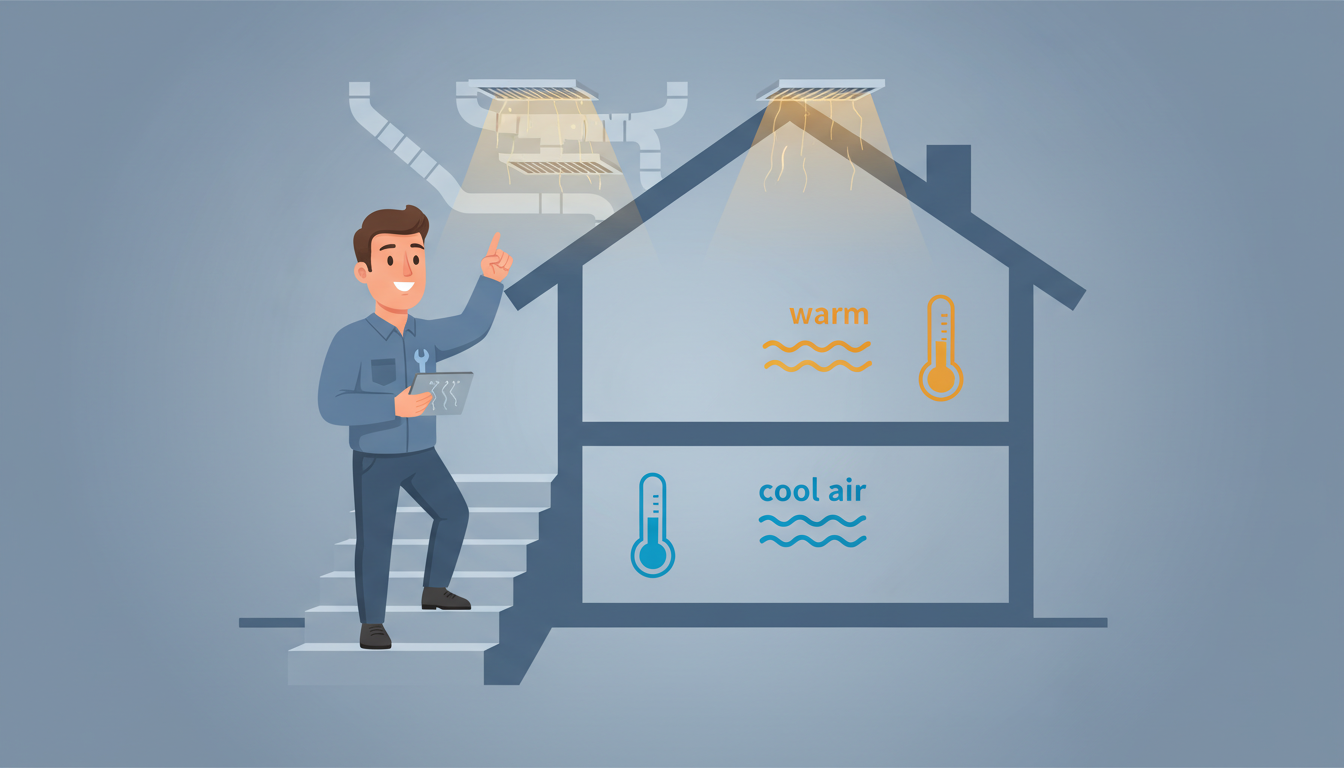
The primary reason your second floor has airflow problems is simple physics: hot air rises. As warm air accumulates on your first floor, it naturally moves upward, making your second floor several degrees warmer than downstairs. This creates an uphill battle for your HVAC system, which must work harder to push cool air against this natural temperature gradient.
When your air conditioning tries to cool the second floor, it's essentially fighting gravity and thermodynamics. Cold air is denser and heavier than warm air, so it naturally sinks back down to the first floor through stairwells and open areas.
The Stack Effect in Two-Story Homes
Two-story homes also experience what HVAC professionals call the "stack effect." As your home heats up during the day, warm air rises and creates positive pressure at the top of your house while creating negative pressure at the bottom. This pressure difference pulls cool air downstairs and pushes hot air upstairs, making second floor airflow issues even worse.
Common Causes of Poor Airflow to Second Floor
1. HVAC System Location and Distance
If your HVAC unit is located on the first floor or in the basement, your second floor is at a significant disadvantage. The farther air has to travel through ductwork, the more it loses pressure and velocity. Every foot of distance, every bend, and every turn in your ducts creates friction and turbulence that reduces airflow.
Think of your ductwork like a garden hose. The longer the hose and the more kinks it has, the weaker the water pressure at the end. The same principle applies to airflow in your home.
2. Undersized or Poorly Designed Ductwork
Many homes have ductwork that wasn't properly sized for the second floor from the beginning. If your ducts are too small, they create a bottleneck that restricts airflow. Even worse, some homes have ductwork with too many bends, turns, and transitions that create excessive static pressure.
When static pressure builds up in your ductwork, your blower fan has to work much harder to push air through. This not only reduces airflow to second floor vents but also increases your energy bills and wears out your HVAC equipment faster.
3. Insufficient Return Air Vents Upstairs
Here's something most homeowners overlook: your second floor needs adequate return air vents, not just supply vents. Return vents pull air back to your HVAC system to be cooled and recirculated. Without enough return air capacity upstairs, your system can't establish proper air circulation.
If all your return vents are on the first floor, cool air gets pushed upstairs but has no efficient path back to the system. This creates positive pressure on the second floor that actually fights against the supply vents trying to blow cool air into your rooms.
4. Dirty or Clogged Air Filters
A dirty air filter is one of the easiest problems to fix but also one of the most common causes of poor airflow to second floor rooms. When your filter gets clogged with dust, pet hair, and debris, it restricts airflow throughout your entire system. Since the second floor already receives less air due to distance and physics, a dirty filter makes the problem significantly worse.
Learn more about maintaining your HVAC system to prevent common airflow issues.
5. Closed or Blocked Vents and Registers
Walk through your second floor right now and check every vent. Are furniture, curtains, or boxes blocking any of them? Are any vents accidentally closed? Even partially blocked vents dramatically reduce airflow. Each blocked vent forces air to redirect elsewhere, throwing off the balance your HVAC system needs to cool your second floor effectively.
6. Thermostat Placement Issues
If your thermostat is located on the first floor, it only reads the temperature downstairs. When the first floor reaches your set temperature, the system shuts off even though your second floor might still be 5-10 degrees warmer. This is a major cause of uneven temperature between floors and leads to chronic second floor airflow problems.
7. Leaking Ductwork
According to HVAC industry studies, the average home loses 20-30% of conditioned air through duct leaks before it ever reaches the vents. For second floor rooms at the end of long duct runs, this problem is even more severe. Leaks in attic ductwork are especially problematic because they dump your expensive cooled air into a space that can reach 150°F in summer.
If you're experiencing weak airflow from vents, duct leaks could be the culprit.
8. Inadequate Attic Insulation and Ventilation
Your attic acts like a heat radiator sitting directly on top of your second floor. Without proper insulation, heat from your attic radiates down into second floor rooms, overwhelming your HVAC system's cooling capacity. Poor attic ventilation makes this worse by trapping superheated air that has nowhere to go but into your living space.
Attic temperatures routinely exceed 140°F in summer. That's like having a giant heating element above your bedrooms fighting against your air conditioning 24/7.
9. Damaged or Crushed Ductwork
Ductwork in attics and crawl spaces can get crushed by storage items, damaged by rodents, or kinked during installation. A crushed duct creates a severe bottleneck that chokes off airflow to any rooms served by that section. This is particularly common in flexible ductwork, which can easily collapse if not properly supported.
How to Fix Second Floor Airflow Problems
Start With the Simple Solutions
Replace Your Air Filter
Before anything else, check your air filter. If you can't remember when you last changed it, replace it now. During heavy use months (summer and winter), filters should be changed every 30-60 days. This simple $20 fix can dramatically improve second floor airflow.
Open All Vents and Clear Obstructions
Make sure every supply and return vent on your second floor is fully open and unobstructed. Move furniture away from vents, remove any covers or decorations, and ensure curtains aren't blocking airflow.
Close Some First Floor Vents (Strategically)
Here's a counterintuitive solution: partially closing vents on the first floor forces more conditioned air upstairs. Don't close them completely, as this increases static pressure and can damage your system. Instead, close first floor vents about halfway in rooms you use less frequently.
Intermediate Solutions That Make a Big Difference
Seal Your Ductwork
Sealing duct leaks is one of the most cost-effective improvements for second floor airflow problems. Focus on accessible ductwork in your attic, basement, or crawl space. Use mastic sealant (not regular duct tape) to seal joints and connections. Professional duct sealing typically costs $500-1,500 and can reduce cooling costs by 20-30%.
Improve Attic Insulation
Adding or upgrading attic insulation reduces the heat load on your second floor. Aim for R-38 to R-60 insulation value depending on your climate. Better insulation means your HVAC system doesn't have to work as hard to keep upstairs rooms comfortable.
Install Attic Ventilation
Proper attic ventilation removes superheated air before it radiates into your second floor. Ridge vents, gable vents, and powered attic fans all help. Reducing attic temperature by 20-30°F makes a noticeable difference in second floor comfort.
Add or Enlarge Return Air Vents
If your second floor has limited return air vents, adding more can dramatically improve air circulation. A qualified HVAC technician can assess whether your return air capacity is adequate and install additional returns if needed. This usually costs $300-800 per vent but solves persistent airflow imbalance.
Use Ceiling Fans Strategically
Ceiling fans don't cool the air, but they do improve air circulation and make rooms feel 3-4°F cooler. In summer, fans should rotate counterclockwise to push air down. Running ceiling fans in second floor bedrooms allows you to set your thermostat 2-3°F higher while maintaining comfort, which reduces the workload on your HVAC system.
Advanced Solutions for Persistent Problems
Install a Zoning System
A zoning system uses motorized dampers in your ductwork to direct airflow where it's needed most. With separate thermostats for upstairs and downstairs, you can cool each zone independently. Zoning systems cost $2,000-4,500 installed but provide precise control over second floor temperatures.
This is particularly effective if there are airflow problems similar to refrigerant problems affecting your system performance.
Add a Second HVAC System
For large two-story homes or homes with severe airflow imbalance, installing a dedicated HVAC system for the second floor is sometimes the best solution. This eliminates the problem of pushing air upstairs entirely. While expensive ($4,000-10,000+), a dual-system setup provides ultimate control and often pays for itself through improved efficiency and comfort.
Install a Ductless Mini-Split System
Ductless mini-split systems offer a middle-ground solution. These systems install directly in problem rooms without requiring ductwork. A single outdoor unit can serve multiple indoor units, each with its own temperature control. Mini-splits are highly efficient and cost $3,000-5,000 per zone.
Upgrade to a Variable-Speed HVAC System
Modern variable-speed HVAC systems adjust airflow and capacity to match your home's needs throughout the day. Unlike single-stage systems that run at 100% or off, variable-speed systems can operate at 25-100% capacity. This provides more consistent airflow to second floor rooms and better humidity control. Expect to invest $5,000-12,000 for a full system replacement.
Balance Your Ductwork System
Professional duct balancing involves adjusting dampers throughout your ductwork to optimize airflow to each room. HVAC technicians use airflow meters to measure CFM (cubic feet per minute) at each vent and adjust dampers until the system delivers the right amount of air to every room. This service costs $200-500 but can solve stubborn airflow imbalances.
How to Test If You Have Airflow Problems
The Tissue Test
Hold a tissue in front of each second floor supply vent. The tissue should be pulled firmly against the vent by the airflow. If it barely moves or falls, that vent has weak airflow that needs attention.
Temperature Differential Test
Use an infrared thermometer to measure air temperature coming from second floor vents. It should be 15-20°F cooler than room temperature. If the difference is smaller, your system isn't delivering enough cooling capacity upstairs.
Room-to-Room Comparison
Measure the temperature in multiple second floor rooms and compare them to first floor rooms. A difference of 2-3°F is normal. If your second floor is 5-10°F warmer, you have a significant airflow problem that needs professional attention.
When to Call an HVAC Professional
Some second floor airflow problems require professional diagnosis and repair:
- Your HVAC system is more than 15 years old
- You've tried basic fixes with no improvement
- Some rooms get no airflow at all
- Your energy bills have increased significantly
- You hear unusual noises from ductwork or equipment
- Ice forms on your outdoor unit or refrigerant lines
- Your system short-cycles (turns on and off frequently)
An HVAC technician can perform a complete system evaluation including static pressure testing, duct leakage testing, and airflow measurement to identify exactly what's causing poor airflow to your second floor.
Seasonal Considerations for Second Floor Airflow
Summer Challenges
Summer creates the worst second floor airflow problems. The combination of hot outdoor temperatures, intense sun exposure on your roof, and superheated attics creates a perfect storm for upstairs discomfort. If your second floor becomes unbearable only in summer, focus on attic insulation, ventilation, and solar window treatments.
Winter Airflow Issues
While less common, some homes experience second floor airflow problems in winter too. Since warm air naturally rises, your second floor might actually get too much heat while the first floor stays cold. Closing or partially closing upstairs vents in winter redirects warm air downstairs where you need it.
Prevention and Maintenance Tips
Regular HVAC Maintenance
Schedule professional HVAC maintenance twice yearly—once before cooling season and once before heating season. Technicians clean coils, check refrigerant levels, test airflow, and catch small problems before they become major second floor airflow issues.
Change Filters Consistently
Set a reminder on your phone to check your air filter monthly. In homes with pets or allergies, filters may need replacement every 30 days. During light-use seasons, every 90 days is usually sufficient.
Keep Vents Clean
Vacuum supply and return vents quarterly to remove dust buildup. Clean vents allow air to flow freely and prevent particles from recirculating through your home.
Monitor Your Attic
Check your attic periodically for damaged insulation, duct problems, or ventilation issues. Catching problems early prevents them from affecting second floor comfort.
FAQ About Second Floor Airflow Problems
Why is my second floor so hot even with AC running?
The most common causes are insufficient return air vents upstairs, duct leaks, poor attic insulation, and thermostat placement on the first floor. Hot air naturally rises, and without adequate airflow and proper insulation, your second floor will stay warmer than downstairs.
How can I cool my upstairs without a second AC unit?
Try these solutions first: seal duct leaks, improve attic insulation, add return air vents upstairs, partially close first floor vents, use ceiling fans, and consider a zoning system. These approaches cost less than a second AC unit and often solve the problem completely.
Should I close downstairs vents to force more air upstairs?
You can partially close first floor vents in rooms you use less frequently, but never close them completely. Closing too many vents increases static pressure in your ductwork, which can damage your HVAC equipment and actually reduce overall system efficiency.
How much does it cost to fix second floor airflow problems?
Simple fixes like new air filters cost $20-50. Duct sealing and insulation improvements run $500-2,000. Adding return vents costs $300-800 each. Zoning systems cost $2,000-4,500. A dedicated second-floor HVAC system costs $4,000-10,000+. Start with inexpensive solutions and work your way up if problems persist.
Can poor airflow damage my HVAC system?
Yes. When second floor airflow problems are caused by restricted airflow (dirty filters, closed vents, duct blockages), your system works harder than designed. This leads to frozen evaporator coils, compressor failure, and shortened equipment lifespan. Addressing airflow issues protects your HVAC investment.
Take Action on Your Second Floor Airflow Problems
Don't suffer through another summer with an unbearably hot second floor. Start with the simple, inexpensive fixes—change your filter, open all vents, check for duct leaks you can see, and improve attic insulation. These DIY solutions solve many common airflow problems.
If basic fixes don't improve your second floor comfort within a few weeks, contact a qualified HVAC professional for a comprehensive system evaluation. The right solution will make your entire home comfortable while reducing energy costs and extending the life of your HVAC equipment.
Your second floor airflow problems have a solution. Whether it's a simple filter change or a more involved system upgrade, taking action now means you'll enjoy consistent comfort throughout your home all year long.