
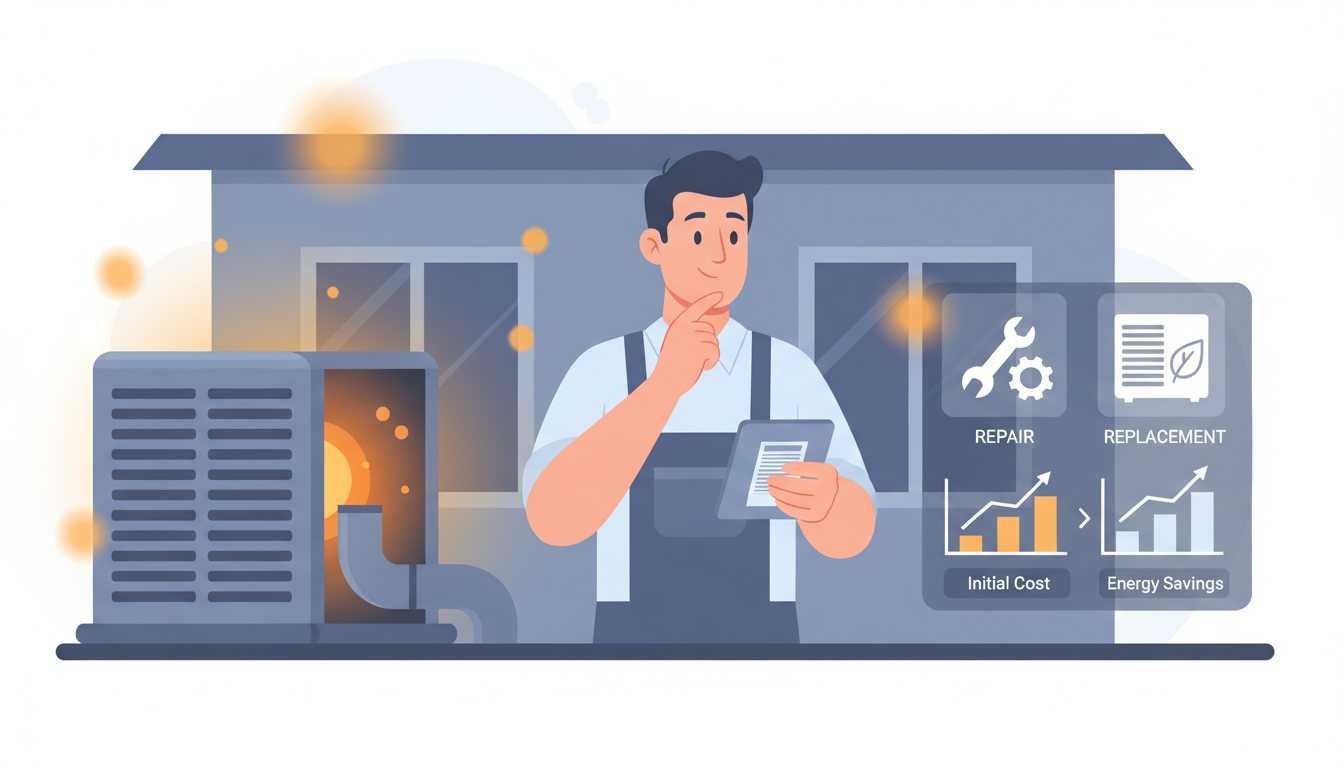
Why Utility Bills Matter in the Repair vs Replace Equation
Why Utility Bills Matter in the Repair vs Replace Equation
When your HVAC system breaks down, the repair estimate feels like the only number that matters. But here's what most homeowners miss: your monthly utility bills hold the real answer to whether you should repair or replace your system. Those rising energy costs you've been ignoring? They're quietly draining your wallet every single month, and they're about to make your repair-or-replace decision crystal clear.
The Hidden Cost Most Homeowners Ignore
You focus on the $1,200 repair quote sitting on your kitchen counter. Meanwhile, your aging HVAC system is costing you an extra $40 to $80 every month in wasted energy. Over a year, that's $480 to $960 disappearing from your bank account—and you probably didn't even notice.
Here's the truth: Heating and cooling account for nearly half of your home's total energy consumption. When your system becomes inefficient, it doesn't just work harder—it costs significantly more to operate every single day.
Why Your Bills Keep Rising
Your HVAC system doesn't die overnight. It slowly loses efficiency as components wear down, refrigerant levels drop, and parts work harder to maintain the same temperature. This gradual decline shows up in your utility bills long before your system stops working completely.
Even if your system still turns on every day, you might be paying 20% to 40% more for energy than you would with a modern, efficient unit. That's money you'll never get back, month after month, year after year.
How to Read the Warning Signs in Your Utility Bills
Your energy bills tell a story about your HVAC system's health. You just need to know how to read them.
Compare Year-Over-Year Costs
Pull out your utility bills from the same months last year. Are you paying more this year for the same cooling or heating? If your bills have jumped 15% to 25% without a corresponding increase in usage or rate changes, your system is losing efficiency fast.
What to look for:
- Summer cooling bills that are significantly higher than last summer
- Winter heating costs that keep climbing year after year
- Gradual increases that add up to substantial differences over 2-3 years
Calculate Your Monthly Energy Waste
Here's a simple way to estimate what inefficiency is costing you:
- Find your highest summer cooling bill from three years ago
- Compare it to last summer's highest bill (adjust for any rate increases)
- The difference is likely your efficiency loss
If that difference is $50 per month during cooling season (typically 6 months), you're wasting $300 annually just on cooling. Add heating season, and inefficiency could be costing you $500+ every year.
The Seasonal Spike Test
Your HVAC system works hardest during extreme temperatures. Pay attention to your bills during peak summer and winter months. If you're seeing dramatic spikes that weren't there a few years ago—even though your thermostat settings haven't changed—your system is struggling.
An efficient system maintains relatively consistent performance even during temperature extremes. An aging, inefficient system has to work exponentially harder when it's 95°F outside, and that shows up as shocking utility bills.
Understanding Energy Efficiency Ratings and Real Savings
When HVAC contractors mention SEER ratings and efficiency percentages, it sounds like sales talk. But these numbers directly translate to dollars on your utility bill.
What SEER Ratings Actually Mean for Your Wallet
SEER stands for Seasonal Energy Efficiency Ratio. It measures how efficiently your air conditioner converts electricity into cooling. The higher the SEER, the less electricity you use for the same cooling power.
Here's what that looks like in real money:
- A 10-year-old system typically has a SEER rating of 10-13
- Modern minimum-efficiency systems start at SEER 14
- High-efficiency systems range from SEER 16 to SEER 20+
Upgrading from a SEER 10 system to a SEER 16 system cuts your cooling energy consumption by approximately 37%. If you currently spend $200 per month cooling your home in summer, a new system could reduce that to $126—saving you $74 every month during cooling season.
Annual Savings That Add Up Fast
Modern high-efficiency HVAC systems typically save homeowners $100 to $140 annually compared to older units—and that's for moderate-efficiency upgrades. If you're replacing a truly old system (15+ years) with a high-efficiency model, savings can reach $300 to $500 per year.
These aren't theoretical numbers. These are real dollars that stay in your pocket instead of going to your utility company.
The Compounding Effect of Rising Energy Rates
Energy costs don't stay flat. Utility rates tend to increase 2% to 4% annually. When you're running an inefficient system, those rate increases hit you harder because you're consuming more energy.
Two scenarios over 5 years:
Scenario 1 - Keep the old system:
- Current annual cost: $1,800
- With 3% annual rate increases: You'll pay $9,828 total over 5 years
- Efficiency continues declining, costs rise even faster
Scenario 2 - Replace with efficient system:
- New annual cost: $1,200 (33% reduction)
- With 3% annual rate increases: You'll pay $6,552 total over 5 years
- Savings over 5 years: $3,276
That $3,276 difference is enough to cover a significant portion of your replacement cost—and you'll keep saving for the entire 15-20 year lifespan of your new system.
The Real Payback Period: When Utility Savings Justify Replacement
Your contractor says a new system costs $6,500. The repair would cost $1,800. Repair seems cheaper—until you factor in utility bill savings.
Calculate Your True Payback Period
Here's the formula that changes everything:
Payback Period = (Replacement Cost - Repair Cost) ÷ Annual Utility Savings
Let's work through a real example:
- New HVAC system: $6,500
- Major repair: $1,800
- Difference: $4,700
- Annual utility savings with new system: $400
Payback period: $4,700 ÷ $400 = 11.75 years
This means in less than 12 years, the utility savings alone will have paid for the difference between repair and replacement. Since new systems last 15-20 years, you'll enjoy 3-8 years of pure savings after breaking even.
When the Payback Period Makes Replacement Obvious
If your payback period is under 7-8 years, replacement is almost always the smart financial move. Here's why:
- You'll likely need another major repair within 2-3 years (adding more costs)
- Your old system will keep losing efficiency (increasing the savings gap)
- You'll benefit from improved comfort and reliability
- You can take advantage of federal tax credits (up to $2,000 for heat pumps through 2025)
Tax credits and rebates can shorten your payback period dramatically. A $2,000 tax credit reduces the example above to 9.5 years—making replacement even more attractive.
Don't Forget About Avoided Future Repairs
When calculating payback, many homeowners only compare the current repair cost to replacement. But aging systems rarely stop at one repair.
If your 14-year-old system needs a $1,800 compressor replacement today, statistics show you'll likely face:
- Another $500-$1,000 repair within 18-24 months
- Continued efficiency decline adding $30-$60 monthly to utility bills
- A complete system failure within 3-5 years anyway
Add those inevitable costs to your calculation, and replacement often pays for itself in 5-6 years instead of 10-12.
How Age and Efficiency Work Together
System age and efficiency are connected, but they're not the same thing. Understanding this relationship is crucial for making the right decision.
The Efficiency Decline Curve
HVAC systems don't maintain steady efficiency throughout their lifespan. Here's what typically happens:
Years 1-5: Minimal efficiency loss with proper maintenance Years 6-10: Gradual decline, 5-10% efficiency reduction Years 11-15: Accelerated decline, 15-25% efficiency loss Years 15+: Rapid deterioration, 25-40%+ efficiency loss
This means a 15-year-old system isn't just old—it's likely using 30% more energy than when it was new. That efficiency loss gets worse every year you keep it running.
The Critical 12-Year Threshold
Most HVAC professionals use 12-15 years as a decision threshold, and utility bills explain why. After 12 years:
- Efficiency has declined enough to cause noticeable bill increases
- Components are wearing out, leading to more frequent repairs
- New technology has advanced significantly, offering 30-50% better efficiency
- The system is approaching the end of its expected lifespan anyway
If your system is 12+ years old and your utility bills are rising, repair is usually just delaying the inevitable—while costing you money every month.
Modern Technology Advantages
Today's HVAC systems aren't just more efficient—they're smarter:
- Variable-speed compressors adjust output instead of cycling on/off constantly, saving 20-30% on energy
- Smart thermostats learn your schedule and optimize runtime, reducing waste
- Two-stage systems run at lower capacity most of the time, using less energy
- Better refrigerants (R-410A instead of R-22) transfer heat more efficiently
These technological improvements mean even a standard SEER 14 system today significantly outperforms a 10-year-old SEER 13 system—because efficiency ratings don't capture all the real-world performance advantages.
Red Flags: When Utility Bills Scream "Replace"
Some utility bill patterns make the decision obvious. Watch for these warning signs.
Your Bills Are Rising Despite Using Less
If you're being more conservative with your thermostat—setting it warmer in summer or cooler in winter—but your bills are still climbing, your system is in serious decline.
This means the efficiency loss is outpacing your conservation efforts. At this point, you're fighting a losing battle. Every dollar you try to save is being consumed by an inefficient, struggling system.
Summer Bills Now Exceed $200-$250 Monthly
For an average-sized home (1,500-2,000 sq ft), summer cooling bills over $200-$250 per month often indicate serious inefficiency—unless you live in an extreme climate or have an unusually large home.
Modern systems in the same home might cost $120-$150 monthly for the same comfort level. That $80-$100 monthly difference ($480-$600 per cooling season) is pure waste.
Your Bills Are Higher Than Your Neighbors'
If your home is similar in size to your neighbors' homes, and you're all using the same utility company, but your bills are 30-50% higher—your system is likely the culprit.
This comparison isn't perfect (insulation, windows, and thermostats matter too), but it's a useful reality check. Significantly higher bills often mean significantly worse equipment efficiency.
Bills Spike Earlier Each Season
If your system used to handle mild spring and fall weather without running much, but now it runs constantly even when it's only 75°F outside, efficiency has declined dramatically.
This "working harder than it should" pattern means the system can't deliver adequate cooling without running continuously—a clear sign it's time to replace before you face summer's peak temperatures (and peak bills).
Making the Decision: A Utility Bill Framework
Let's bring this all together into a practical decision framework based on your utility bills.
Repair Makes Sense When:
- Your utility bills are stable or only slightly higher than 2-3 years ago
- The system is under 10 years old
- Repair cost is under $500-$800
- Your energy costs are reasonable for your home size and climate
- Bills spike only occurred after a specific, repairable failure
Example: Your 7-year-old system has a failed capacitor ($350 repair). Your bills have been steady. The system was working efficiently until this failure. Repair is the right call.
Replacement Makes Sense When:
- Bills have increased 20%+ over the past 2-3 years without usage changes
- The system is 12+ years old
- Major repair costs $1,200+
- You're spending $400+ more annually on energy than you should
- Payback period on utility savings is under 8 years
Example: Your 14-year-old system needs a $1,800 compressor. Bills have climbed from $140 to $195 monthly in summer over 3 years. Annual energy waste is approximately $400. Payback period is 9 years, but you'd avoid future repairs and immediately stop wasting $400 yearly. Replacement is the right call.
The Gray Area
Some situations fall in between. If you're unsure, get a professional energy audit. Many utility companies offer free or low-cost audits that can:
- Identify whether your HVAC system is the primary efficiency problem
- Quantify exactly how much energy your system is wasting
- Calculate your specific savings potential with replacement
- Reveal other issues (insulation, air leaks) that might also need attention
An audit removes the guesswork and gives you hard numbers for your specific situation.
Maximizing Your Investment Through Utility Savings
Once you decide to replace, you can maximize the return on your investment through smart choices that further reduce utility bills.
Right-Sizing Matters for Efficiency
Installing a correctly-sized system is crucial for both comfort and utility costs. An oversized system:
- Short-cycles, turning on and off frequently
- Wastes energy during constant starts and stops
- Wears out components faster
- Costs more upfront and monthly
An undersized system runs constantly, never quite achieving comfortable temperatures while driving up bills. Professional load calculations ensure you get exactly the right size for maximum efficiency.
High-Efficiency Features Worth Paying For
Some upgrades deliver fast payback through utility savings:
Variable-speed air handlers ($300-$600 more): Save 15-25% on energy, pay back in 3-5 years
Two-stage compressors ($400-$800 more): Run at lower capacity most of the time, save 20-30%, pay back in 4-6 years
Smart thermostats ($150-$300): Optimize runtime automatically, save 10-15%, pay back in 2-3 years
Zoned systems ($1,500-$3,000 more for multi-zone): Heat/cool only occupied areas, save 20-30% in larger homes, pay back in 7-10 years
Calculate whether each upgrade's energy savings justify its upfront cost based on your specific usage patterns.
Take Advantage of Financial Incentives
Federal tax credits can dramatically improve your utility-savings payback:
- Heat pumps: 30% tax credit up to $2,000 (through 2025)
- Central air conditioners: Tax credits up to $600
- ENERGY STAR systems: May qualify for additional local utility rebates
Check with your utility company for additional rebates—some offer $300-$1,000 for high-efficiency installations, shortening your payback period by 1-2 years.
Beyond the Numbers: Quality of Life Improvements
While we've focused on utility bills and financial calculations, don't overlook the comfort improvements that come with a new, efficient system.
Modern systems provide:
- More consistent temperatures throughout your home (no more hot/cold spots)
- Better humidity control (making your home feel comfortable at higher thermostat settings)
- Quieter operation (newer compressors and air handlers are significantly quieter)
- Improved air quality (better filtration and ventilation options)
These improvements let you set your thermostat more conservatively without sacrificing comfort—leading to even greater utility savings than efficiency ratings alone predict.
Taking Action: Your Next Steps
If rising utility bills have you questioning whether to repair or replace your HVAC system, here's your action plan:
- Gather your utility bills from the past 2-3 years and look for patterns
- Calculate your year-over-year increases to quantify efficiency loss
- Get repair estimates and replacement quotes from reputable contractors
- Calculate your payback period using annual utility savings
- Factor in tax credits and rebates available in your area
- Consider system age and likelihood of future repairs
For more guidance on making the repair vs. replace decision, check out our HVAC repair guide for detailed decision frameworks. If you're facing an immediate breakdown and need to decide quickly, our HVAC emergency repair resource can help you make smart decisions under pressure.
Looking for a quick way to evaluate all the factors at once? Download our simple repair vs replace checklist for homeowners to organize your decision-making process.
FAQ: Utility Bills and HVAC Replacement
How much will a new HVAC system lower my utility bills?
Most homeowners save $100-$500 annually depending on their old system's efficiency. If you're replacing a 15+ year-old system with a modern high-efficiency unit, savings typically range from $300-$500 per year. Moderate upgrades from 10-year-old systems save $100-$200 annually. Calculate your specific savings by comparing your current system's SEER rating to the new system's rating—each point of SEER improvement reduces cooling costs by approximately 5-7%.
What utility bill increase indicates I should replace my HVAC?
If your bills have increased 20% or more over 2-3 years without corresponding usage increases or rate hikes, it's time to seriously consider replacement—especially if your system is 10+ years old. Annual increases of $300-$500 often signal efficiency decline severe enough to justify replacement based on utility savings alone.
How long does it take for utility bill savings to pay back a new HVAC system?
Typical payback periods range from 7-12 years when factoring only utility savings. However, when you include avoided future repairs (which are likely with aging systems) and available tax credits, effective payback often shortens to 5-8 years. Since new systems last 15-20 years, you'll enjoy 7-15 years of net savings after breaking even.
Can improving other parts of my home reduce utility bills instead of replacing HVAC?
Yes—insulation, air sealing, window upgrades, and efficient lighting all reduce energy costs. However, if your HVAC system is 12+ years old and inefficient, it's likely your single biggest energy waste. An energy audit can determine whether HVAC or other improvements offer better return on investment. Often, combining an efficient HVAC system with good insulation delivers the best results.
Are high-efficiency HVAC systems worth the extra cost?
Usually yes, when utility bill savings are factored in. A SEER 16 system might cost $1,000-$1,500 more than a SEER 14 system, but saves an additional $100-$150 annually. That premium pays for itself in 7-10 years, then continues saving money for the rest of the system's 15-20 year lifespan—totaling $1,500-$3,000 in extra savings beyond the upfront cost difference.
Conclusion: Let Your Utility Bills Guide Your Decision
The repair or replace question isn't just about the immediate cost staring you in the face. Your utility bills tell the real story—showing you exactly how much money your system is wasting every single month.
If your bills have been creeping up year after year, that aging HVAC system is costing you far more than any repair estimate suggests. Those wasted dollars add up to thousands over time—money that could be paying for a new, efficient system instead.
Do the math. Calculate your actual annual waste. Factor in the utility savings you'll gain with replacement. More often than not, your utility bills will make the decision clear: replacement isn't just the right choice for comfort and reliability—it's the smart financial move that pays you back month after month, year after year.
Don't let rising utility bills quietly drain your budget while you delay the inevitable. The sooner you replace an inefficient, aging system, the sooner you stop wasting money and start saving it.