Capacitor Problem vs Motor Problem: How to Tell the Difference in Your HVAC System
Capacitor Problem vs Motor Problem: How to Tell the Difference in Your HVAC System
When your air conditioner suddenly stops working on a hot summer day, you're facing one of two common culprits: a failed capacitor or a bad motor. While both can leave you sweating, knowing the difference between a capacitor problem and a motor problem can save you hundreds—even thousands—of dollars in unnecessary repairs.
Understanding these differences isn't just about saving money. It's about protecting yourself from potential scams and making informed decisions when a technician tells you what needs fixing. Let's break down exactly how to identify whether you're dealing with a capacitor issue or a motor failure.
What Does a Capacitor Do in Your HVAC System?
Think of your HVAC capacitor as the electrical jumpstart your system needs to get moving. This small cylindrical component stores and releases electrical energy to give motors the boost they need to start up and keep running.
Your air conditioning system actually uses two types of capacitors:
Start Capacitors provide a powerful surge of energy to get the motor spinning from a complete stop. Once the motor reaches about 75% of its operating speed, the start capacitor disconnects.
Run Capacitors stay engaged while the motor operates, providing continuous electrical support to keep everything running smoothly and efficiently.
Many modern HVAC systems use a dual run capacitor that combines both functions in a single component, powering both your compressor and condenser fan motor.
What Does a Motor Do in Your HVAC System?
Your HVAC system relies on multiple motors to keep your home comfortable:
Blower Motor moves air through your ductwork and into your living spaces. Located in your indoor air handler, this motor keeps air circulating throughout your home.
Condenser Fan Motor sits in your outdoor unit and spins the fan that releases heat from your system into the outside air.
Compressor Motor drives the compressor that pressurizes refrigerant and moves it through your AC system—essentially the heart of your cooling system.
When any of these motors fail, your system can't function properly. Understanding which motor is affected helps narrow down the problem.
Key Signs You Have a Capacitor Problem
Capacitor problems show up with distinct symptoms that make diagnosis easier if you know what to listen and look for.
Your Unit Hums But Won't Start
This is the classic sign of capacitor failure. When you hear a humming or buzzing sound from your outdoor unit but the fan doesn't spin, your motor is trying to start but doesn't have enough electrical boost to get moving. The capacitor should provide that initial surge of power—when it fails, the motor stays stuck.
Here's a simple test: if you carefully push the fan blades with a stick (never use your hands while the unit is powered on), and the fan starts spinning on its own, you almost certainly have a bad capacitor. A functioning motor can keep running once it gets moving, but without a working capacitor, it can't start on its own.
The System Short Cycles
Short cycling means your AC turns on and off repeatedly in short bursts instead of running through complete cooling cycles. A failing run capacitor can't provide consistent power to keep the motor running efficiently, causing the system to shut down prematurely and restart. This pattern puts enormous strain on your equipment and drives up your energy bills while wearing out components faster.
Visible Damage to the Capacitor
Capacitors often show physical signs of failure. When you open your outdoor unit's access panel, look for:
- Bulging or swelling at the top of the cylindrical capacitor
- Rust or corrosion on the terminals
- Oily residue or leaking fluid
- Cracks or splits in the casing
Any of these visual cues means immediate replacement is needed. A damaged capacitor can cause serious problems for connected motors.
The Unit Takes a Long Time to Start
If your AC hesitates for several seconds before finally kicking on, your start capacitor may be weak but not completely dead. This delayed start puts extra stress on the motor every single time, potentially shortening its lifespan.
Clicking Sounds Every Few Seconds
A failing capacitor trying to release energy makes repeated clicking noises as it attempts to provide power to the motors. This clicking pattern is distinct from the single click you hear during normal system startup.
Key Signs You Have a Motor Problem
Motor failures present differently than capacitor issues. Here's how to recognize when the motor itself has gone bad.
Grinding, Squealing, or Screeching Noises
Unlike the humming of a capacitor problem, motor failure produces mechanical sounds—grinding metal, high-pitched squealing, or loud screeching. These noises indicate worn bearings, damaged windings, or internal components rubbing against each other.
If you hear these sounds, turn off your system immediately. Running a motor with damaged internal components can cause catastrophic failure and potentially damage other system parts.
Burning Smell From the Unit
A distinct burning odor—often described as smelling like burning plastic or overheated electronics—signals motor windings overheating or burning out. While a failing capacitor can sometimes produce electrical odors, the burning smell from a motor problem is typically stronger and more acrid.
This is an emergency situation that requires immediate attention. When electrical problems in HVAC systems escalate, they can create fire hazards.
Complete Silence When the System Tries to Start
If your thermostat calls for cooling but you hear absolutely nothing from the outdoor unit—no humming, no clicking, no fan noise—the motor may be completely dead. This differs from a capacitor problem, which produces at least some sound as the motor attempts to start.
The Fan Spins Slowly or Wobbles
When a motor's bearings wear out or internal components fail, the fan blade may spin slower than normal or wobble visibly. A healthy motor turns the fan at consistent speed with no wobbling motion.
Excessive Heat From the Motor Housing
Touch the motor housing (when the unit is off) and check if it's significantly hotter than the surrounding components. Overheating motors indicate internal problems like damaged windings or bearing failure.
Your Breaker Trips Repeatedly
When a motor starts to fail, it often draws excessive current trying to compensate for internal damage. This overcurrent situation causes your circuit breaker to trip as a safety measure. While breaker trips can have multiple causes, a pattern of tripping specifically when the AC tries to start often points to motor problems.
The Critical Connection: How Capacitor Problems Lead to Motor Failure
Here's what many homeowners don't realize: a bad capacitor can destroy a perfectly good motor if left unaddressed.
When your capacitor fails, the motor must work much harder to start and run without proper electrical support. This extra strain generates excessive heat in the motor windings. Over time, this heat degrades the insulation around the windings, eventually causing the motor to burn out completely.
A capacitor replacement might cost $150-250. But if that failing capacitor damages your motor before you fix it, you're looking at $400-1,200 for a motor replacement—or even $1,800-2,500 if the compressor motor fails.
This is why acting quickly when you notice capacitor symptoms is crucial. What starts as an inexpensive repair can cascade into a major expense.
How to Diagnose: Capacitor or Motor?
Follow this diagnostic approach to identify which component has failed:
Step 1: Listen to Your System
- Humming with no movement = likely capacitor
- Grinding/squealing = likely motor
- Complete silence = could be motor or other electrical issue
- Clicking pattern = likely capacitor
Step 2: Check for Physical Symptoms
- Open the access panel (with power off)
- Inspect the capacitor for bulging, leaking, or damage
- Check if the motor housing shows signs of overheating or damage
- Look for burn marks or melted wiring around components
Step 3: Try the Manual Start Test
- Turn your system on
- If the fan doesn't start but you hear humming, carefully use a wooden stick or dowel to push the fan blade (never use your hands)
- If the fan starts spinning on its own after the push, you have a bad capacitor
- If the fan won't spin even with help, or spins but stops immediately, the motor may be bad
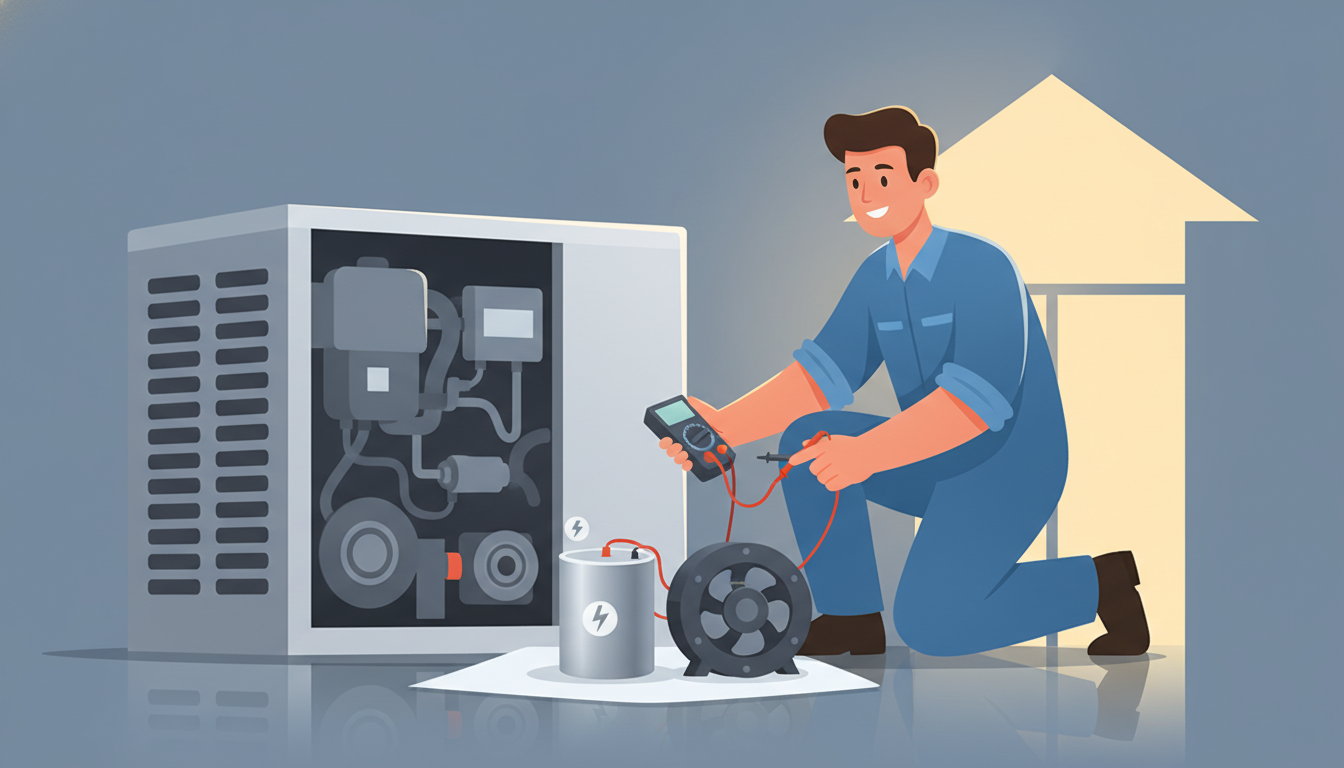
Step 4: Test With a Multimeter (Advanced)
If you're comfortable with electrical testing, you can measure the capacitor's microfarads with a multimeter set to capacitance mode:
- Discharge the capacitor safely first (critical safety step)
- Disconnect the wires and test the capacitance
- Compare the reading to the rating printed on the capacitor
- If the reading is more than 5-6% off from the rated value, the capacitor needs replacement
Testing a motor requires checking resistance across the windings, which is more complex and best left to professionals.
When to Call a Professional
While diagnosis can help you understand the problem, certain situations require immediate professional help:
- Any situation involving a burning smell or visible smoke
- Repeated circuit breaker trips
- You're uncomfortable working around electrical components
- The compressor motor is affected (not just the fan motor)
- You've replaced the capacitor but problems persist
- The motor shows signs of severe damage
Working with HVAC electrical components involves genuine risk. Capacitors store electrical charge even when power is off, and improper handling can result in dangerous shocks. When in doubt, always call a qualified technician.
Cost Comparison: Capacitor vs Motor Replacement
Understanding typical costs helps you evaluate whether a repair quote is reasonable:
Capacitor Replacement:
- Part cost: $15-50 for the capacitor itself
- Labor cost: $100-200 for professional installation
- Total: $150-250 typically
- Time: Usually completed in 30-60 minutes
Motor Replacement:
- Condenser fan motor: $400-800 including labor
- Blower motor: $450-1,200 including labor
- Compressor motor: $1,800-2,500 including labor and refrigerant handling
- Time: 2-4 hours for fan motors, longer for compressor
If a technician quotes you compressor replacement but hasn't tested the capacitor with proper equipment, get a second opinion. The significant cost difference makes capacitor problems a common point where unscrupulous technicians might try to upsell unnecessary repairs.
Preventing Both Capacitor and Motor Problems
Regular maintenance dramatically extends the life of both capacitors and motors:
Annual Professional Maintenance should include:
- Capacitor testing with proper equipment
- Motor amperage testing to detect early problems
- Lubrication of motor bearings (on models that require it)
- Cleaning condenser coils to prevent motor overwork
- Checking all electrical connections
Homeowner Maintenance:
- Keep the outdoor unit clear of debris, leaves, and vegetation
- Replace air filters every 1-3 months to reduce blower motor strain
- Listen for unusual sounds and address them promptly
- Ensure adequate airflow around the outdoor unit
Seasonal Checks: Before cooling season starts, have your system inspected. Most capacitor and motor failures happen during the first heat wave of summer when systems face maximum demand after sitting idle.
FAQ: Common Questions About Capacitor and Motor Problems
Can a bad capacitor damage my motor?
Yes, absolutely. A failing capacitor forces the motor to work harder, generating excessive heat that can burn out motor windings. This is why addressing capacitor problems quickly is so important—a $200 repair can prevent a $1,500 motor replacement.
How long do capacitors typically last?
HVAC capacitors usually last 10-20 years, but factors like extreme heat, frequent cycling, and electrical issues can shorten their lifespan. In very hot climates or with heavy system use, capacitors may only last 5-10 years.
Can I replace a capacitor myself?
While technically possible for someone with electrical knowledge, it's not recommended. Capacitors store dangerous electrical charges even when power is off. Improper discharge procedures can cause severe electrical shock. Professional replacement is safer and often not much more expensive than DIY when you factor in tools and safety equipment.
Why does my unit work sometimes but not others?
This intermittent operation often indicates a capacitor that's weak but not completely dead. As the capacitor degrades, it may work when temperatures are moderate but fail when the system faces higher electrical demands. Eventually, it will fail completely.
Do I need to replace both the capacitor and motor?
Not necessarily, but if a failing capacitor has been affecting the motor for a while, both components may need replacement. A qualified technician should test both to determine what's actually failed. If only the capacitor is bad and you caught it early enough, the motor may be fine.
Taking Action When Problems Arise
When your HVAC system shows signs of trouble, quick action prevents minor issues from becoming major expenses. Understanding the difference between capacitor problems and motor problems empowers you to have informed conversations with technicians and make smart repair decisions.
Remember these key takeaways:
- Humming without starting usually means a bad capacitor
- Grinding or squealing noises typically indicate motor problems
- A bad capacitor can damage a motor if not addressed quickly
- Visual inspection of the capacitor often reveals obvious damage
- Professional diagnosis with proper testing equipment ensures accurate repairs
- Regular maintenance catches problems before they cause breakdowns
Don't wait for a complete breakdown on the hottest day of summer. If you're experiencing any of the symptoms discussed in this guide, schedule an inspection with a qualified HVAC professional. The difference between a capacitor problem and a motor problem might be just a few hundred dollars—but only if you catch it in time.
For more guidance on keeping your HVAC system running reliably, check out our complete HVAC repair guide with troubleshooting tips for homeowners.