
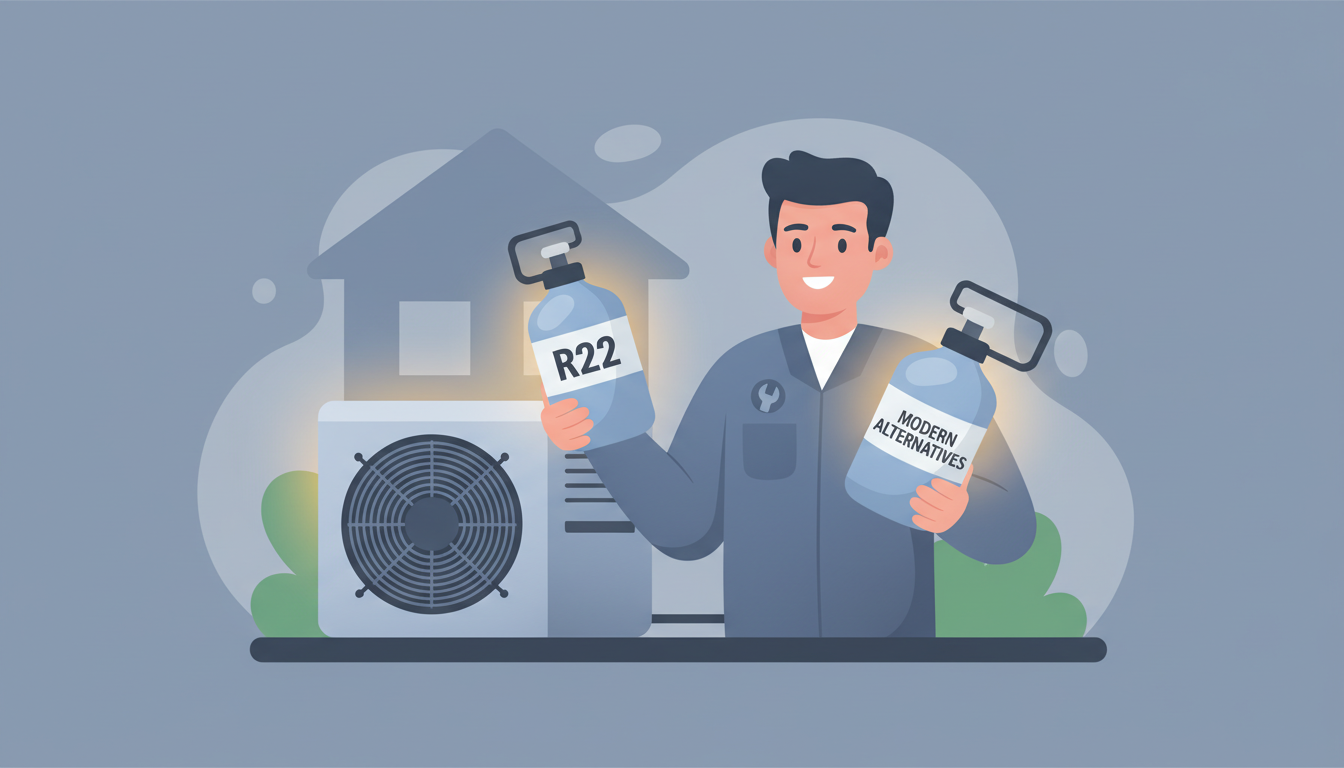
R22 vs Newer Refrigerants: What Repair Customers Need to Know
R22 vs Newer Refrigerants: What Repair Customers Need to Know
Your air conditioner just broke down in the middle of summer, and your HVAC technician delivered bad news: your system uses R22 refrigerant. Now you're facing a tough decision—pay sky-high prices for R22 refrigerant replacement or invest in a completely new system. If you're confused about R22 vs newer refrigerants and what it means for your wallet, you're not alone. This guide breaks down everything repair customers need to know about refrigerant options, costs, and making the smartest choice for your home.
Understanding the R22 Phase-Out: Why Your Refrigerant Matters
R22, commonly known by the brand name Freon, is a hydrochlorofluorocarbon (HCFC) refrigerant that was the industry standard for residential air conditioning systems for decades. However, R22 has a dark side—when released into the atmosphere, it depletes the Earth's ozone layer and contributes to climate change.
The Environmental Protection Agency (EPA) began phasing out R22 production and import as part of the Montreal Protocol, an international agreement to protect the ozone layer. Here's the timeline that affects your air conditioner:
- January 1, 2010: EPA banned production of new equipment using R22
- January 1, 2020: Complete ban on R22 production and import (current status)
- January 1, 2030: Final phase—remaining stockpiles will be severely restricted
Today, R22 can only be obtained from recycled or reclaimed sources, and existing stockpiles are dwindling fast. This scarcity has created a supply-and-demand nightmare for homeowners with older systems. Understanding these regulations is crucial when planning your HVAC repair strategy.
R22 vs Newer Refrigerants: Key Differences
When comparing R22 vs newer refrigerants, there are several critical factors that affect performance, cost, and environmental impact.
R410A: The Current Standard
R410A (brand name Puron) became the primary replacement for R22 in new systems after 2010. This hydrofluorocarbon (HFC) refrigerant offers several advantages:
- Zero ozone depletion: Unlike R22, R410A doesn't damage the ozone layer
- Higher efficiency: Systems using R410A typically achieve higher SEER (Seasonal Energy Efficiency Ratio) ratings
- Better cooling capacity: R410A operates at higher pressures, providing more efficient heat transfer
- More affordable: Currently costs $75-$175 per pound compared to R22's $200-$600+ per pound
However, R410A isn't perfect. It has a high global warming potential (GWP) of 2,088, meaning it contributes significantly to climate change if released into the atmosphere.
A2L Refrigerants: The Next Generation
As of January 1, 2025, the EPA's American Innovation and Manufacturing (AIM) Act requires new air conditioning systems to use refrigerants with a GWP below 750. This regulation has introduced a new class of refrigerants called A2L refrigerants.
The two most common A2L refrigerants are:
- R454B: GWP of 466 (78% lower than R410A)
- R32: GWP of 675 (67% lower than R410A)
A2L refrigerants are classified as "mildly flammable," which sounds concerning but poses minimal risk when properly installed and maintained by certified HVAC technicians. These refrigerants represent the future of residential cooling, balancing environmental responsibility with safety and performance. Learn more about A2L refrigerants and what homeowners should know.
Comparison at a Glance
| Refrigerant | Ozone Depletion | GWP | Status | Average Cost/lb |
|---|---|---|---|---|
| R22 (Freon) | High | 1,810 | Banned since 2020 | $200-$600+ |
| R410A (Puron) | Zero | 2,088 | Being phased out | $75-$175 |
| R454B (A2L) | Zero | 466 | Current standard | $100-$200 |
| R32 (A2L) | Zero | 675 | Current standard | $90-$180 |
Your Options If You Have an R22 System
If your air conditioner uses R22 refrigerant, you have three main options. Each comes with different costs, benefits, and long-term implications.
Option 1: Recharge With R22
You can continue using your existing system and recharge it with recycled or reclaimed R22 when needed.
Pros:
- Lowest upfront cost
- No equipment modifications needed
- Extends life of current system temporarily
Cons:
- R22 prices continue climbing ($200-$600+ per pound in 2026)
- Limited availability—supplies will eventually run out
- A full recharge can cost $1,500-$3,000 or more
- You'll likely face this decision again soon
Best for: Systems less than 10 years old with minor leaks, when you're planning to replace within 1-2 years anyway.
Option 2: Retrofit With Drop-In Refrigerant
Some R22 systems can be retrofitted to use alternative refrigerants like R407C or MO99. This involves recovering the existing R22, flushing the system, replacing certain components, and recharging with the new refrigerant.
Pros:
- Less expensive than full system replacement ($1,500-$3,500 typically)
- Keeps existing equipment functioning
- Uses more readily available refrigerants
Cons:
- Not all systems are compatible—requires professional assessment
- May void existing warranties
- Performance can be reduced compared to original R22 operation
- Requires replacing filters, O-rings, and potentially other components
- Not truly "drop-in"—requires significant labor
Best for: Well-maintained systems 10-15 years old where major components are still in good condition.
Option 3: Replace the Entire System
Installing a new air conditioning system with R410A or A2L refrigerants is the most expensive option upfront but offers the best long-term value.
Pros:
- Latest technology with highest efficiency (16-20+ SEER ratings)
- Energy savings of 20-40% on cooling costs
- Modern features (smart thermostats, variable-speed compressors, zoning)
- Full manufacturer warranty (typically 10 years on parts)
- Future-proof with compliant refrigerants
- Increased home value
Cons:
- Highest upfront investment ($4,000-$8,000+ depending on size and features)
- Installation disruption
Best for: Systems over 15 years old, systems needing frequent repairs, or when you plan to stay in your home long-term.
Cost Comparison: R22 vs Newer Refrigerants in 2026
Let's break down the real costs of each option over a 5-year period to help you make an informed decision.
Scenario 1: Keep R22 System (15-year-old unit)
- Year 1: Refrigerant leak repair + 3 lbs R22 = $1,800
- Year 2: Compressor issue + labor = $1,200
- Year 3: Another leak + 2 lbs R22 = $1,400
- Year 4: Evaporator coil leak + 4 lbs R22 = $3,200
- Year 5: System finally fails, emergency replacement = $6,500
- Total 5-year cost: $14,100
- Energy costs: High (10-12 SEER rating)
Scenario 2: Replace Now With R410A/A2L System
- Year 1: New system installation = $5,500
- Years 2-5: Annual maintenance only = $600 ($150/year)
- Total 5-year cost: $6,100
- Energy costs: Low (16-18 SEER rating saves 30-40% on cooling)
- Additional savings: $300-$600/year in energy costs = $1,200-$2,400 over 4 years
The numbers speak for themselves. While replacing your R22 system requires a larger upfront investment, you'll save money within just a few years while enjoying better comfort, reliability, and energy efficiency.
If you're experiencing issues with your current system, recognizing refrigerant leak symptoms early can help you make a timely decision and avoid costly emergency repairs.
A2L Refrigerants: What Repair Customers Should Know
With the 2025 regulatory changes, A2L refrigerants are now the standard for new residential HVAC systems. Here's what you need to know about these next-generation refrigerants.
Safety Considerations
The term "mildly flammable" understandably raises concerns for homeowners. However, A2L refrigerants require very specific conditions to ignite—conditions that are extremely unlikely to occur in normal residential settings:
- Requires a significant leak (not just a small drip)
- Needs an ignition source at the exact leak location
- Must have proper fuel-to-air ratio
Modern A2L systems include safety features like refrigerant leak detectors and automatic shutoffs. Your licensed HVAC technician must be specially trained and certified to work with A2L refrigerants, ensuring proper installation and maintenance.
Performance and Efficiency
A2L refrigerants perform similarly to R410A while offering significantly better environmental credentials. You won't sacrifice cooling power or comfort when upgrading to an A2L system. In fact, many new systems with A2L refrigerants achieve SEER ratings of 18-20 or higher, meaning lower energy bills and a smaller carbon footprint.
Long-Term Value
Investing in an A2L system now means you're buying technology that will be supported for decades to come. Unlike R22 (now obsolete) and R410A (being phased down), A2L refrigerants meet current and anticipated future environmental regulations. This future-proofing protects your investment and ensures parts and service will remain available.
How to Tell What Refrigerant Your AC Uses
Not sure whether your air conditioner uses R22 or newer refrigerants? Here's how to find out:
Check the Equipment Label
Every air conditioning system has a label on the outdoor condenser unit that specifies the refrigerant type. Look for:
- The metal data plate on the side of the outdoor unit
- Text stating "Refrigerant Type" or similar
- R22, R410A, or other refrigerant designation
The label also shows your system's manufacturing date. Systems manufactured before 2010 almost certainly use R22. Systems from 2010-2024 typically use R410A. Systems manufactured in 2025 or later use A2L refrigerants.
Look at the Color Coding
While not always reliable, refrigerant service ports often use color coding:
- Green: R22
- Pink/Rose: R410A
- Blue: Other refrigerants (varies)
However, don't rely solely on color coding, as these can be replaced or incorrectly installed.
Check Your System's Age
The manufacturing date provides strong clues:
- Before 2010: Almost certainly R22
- 2010-2024: Likely R410A
- 2025+: A2L refrigerants (R454B or R32)
If your system is 15+ years old, you're almost guaranteed to have R22, which means replacement is your most cost-effective long-term option.
Call a Professional
When in doubt, contact a licensed HVAC technician. They can quickly identify your refrigerant type, check for leaks, and provide expert recommendations for your specific situation. A professional assessment costs $75-$150 but can save you thousands in the long run.
When to Repair vs Replace Your R22 System
The repair-or-replace decision depends on several factors beyond just the refrigerant type. Use this framework to make the best choice for your situation.
Repair Your R22 System If:
- System is less than 10 years old and in otherwise good condition
- Minor repair needed (fan motor, capacitor, etc.) that doesn't require refrigerant
- You're planning to move within the next 1-2 years
- Budget is extremely tight and you need a short-term solution
- Only small amount of refrigerant needed (less than 1 pound)
Replace Your R22 System If:
- System is 15+ years old (average lifespan is 15-20 years)
- Major component failure (compressor, evaporator coil, condenser)
- Frequent repairs (you've spent $500+ annually on repairs)
- Large refrigerant leak requiring 3+ pounds of R22
- Your energy bills are high (old system likely operating at 8-10 SEER)
- You plan to stay in your home 5+ more years
- You want improved comfort (better humidity control, more even temperatures)
The $5,000 Rule
HVAC professionals often use the "$5,000 rule" for decision-making: Multiply the repair cost by the system's age in years. If that number exceeds $5,000, replacement is usually the smarter choice.
Example 1: $500 repair × 12-year-old system = $6,000 → Replace
Example 2: $800 repair × 6-year-old system = $4,800 → Repair
This rule isn't perfect, but it provides a helpful guideline when facing tough decisions.
Frequently Asked Questions About R22 vs Newer Refrigerants
Can I still use R22 in my air conditioner in 2026?
Yes, you can legally continue using R22 in your existing air conditioning system. The EPA ban only prohibits producing and importing new R22—it doesn't require you to remove R22 from your current system. However, finding R22 for repairs is increasingly difficult and expensive, with prices ranging from $200-$600+ per pound. Most HVAC professionals recommend replacing R22 systems rather than continuing to repair them.
How much does it cost to replace an R22 air conditioner?
Replacing an R22 air conditioning system with a new unit using R410A or A2L refrigerants typically costs $4,000-$8,000 for a complete installation. Factors affecting price include system size (tonnage), SEER rating, brand, regional labor costs, and installation complexity. Higher-efficiency systems (18+ SEER) cost more upfront but save significantly on energy bills—often paying for themselves within 7-10 years through reduced cooling costs.
What's the difference between R410A and A2L refrigerants?
R410A and A2L refrigerants both offer zero ozone depletion, but A2L refrigerants have much lower global warming potential (GWP). R410A has a GWP of 2,088, while A2L refrigerants like R454B (GWP 466) and R32 (GWP 675) are 67-78% better for the environment. A2L refrigerants are classified as "mildly flammable" but include safety features that make them safe for residential use. As of 2025, new systems must use A2L refrigerants to meet EPA regulations.
Is it worth converting my R22 system to R410A?
Converting an R22 system to R410A is generally not recommended because these refrigerants operate at significantly different pressures. R410A runs at about 50% higher pressure than R22, meaning your existing compressor, condenser, and evaporator coil aren't designed to handle it safely. True conversion requires replacing nearly all major components—essentially a new system at the cost of a partial retrofit. You're better off investing that money in a complete replacement with warranty coverage and modern efficiency.
How long will R22 be available for repairs?
R22 from recycled and reclaimed sources is currently available but becoming scarcer each year. The EPA hasn't set a final cutoff date for using existing R22 stocks, but supply continues to shrink as systems are retired and refrigerant is lost to leaks. Most industry experts predict R22 will become prohibitively expensive or effectively unavailable by 2028-2030. If your system needs R22 now, it's wise to plan for replacement within the next 1-3 years rather than counting on continued availability.
Make the Smart Choice for Your Home and Wallet
Understanding R22 vs newer refrigerants empowers you to make informed decisions when your air conditioner needs repair. While the R22 phase-out creates challenges for homeowners with older systems, it also presents an opportunity to upgrade to more efficient, environmentally friendly, and cost-effective cooling technology.
If your system uses R22 and needs significant repairs, the math strongly favors replacement over continued repairs—especially if your system is over 15 years old. A new system with A2L refrigerants will save you money on energy bills, reduce emergency repair costs, improve your home comfort, and protect the environment for future generations.
Don't wait until your R22 system fails during the hottest day of summer. Contact a licensed HVAC professional today for a thorough assessment of your system and a detailed cost comparison of your options. Making a proactive decision now gives you time to research, compare quotes, and choose the best system for your needs—without the pressure and premium pricing of an emergency replacement.
Your air conditioner is one of your home's most important systems. Choose wisely, and you'll enjoy reliable, efficient cooling for 15-20 years to come.