Symptoms of a Bad Furnace Control Board: Complete Guide for Homeowners
Symptoms of a Bad Furnace Control Board: Complete Guide for Homeowners
Is your furnace acting up? Whether it's refusing to turn on, running non-stop, or shutting off at random times, you might be dealing with a bad furnace control board. The control board is essentially your furnace's brain, and when it fails, your entire heating system can malfunction. In this guide, we'll walk you through the most common symptoms of a bad furnace control board so you can identify the problem early and get your home warm again.
What Is a Furnace Control Board?
Before we dive into the symptoms, let's quickly cover what a furnace control board actually does. Your furnace control board (also called a circuit board or integrated control board) is the central hub that manages all of your heating system's operations. It receives signals from your thermostat, coordinates the ignition sequence, controls the blower motor, regulates the gas valve, and monitors safety switches like the flame sensor and limit switches.
Think of it as the conductor of an orchestra—when the control board is working properly, all your furnace components work in perfect harmony. But when it fails, everything falls apart.
Top 7 Symptoms of a Bad Furnace Control Board
Recognizing the warning signs of a failing control board can save you from a complete heating system breakdown and potentially expensive emergency repairs. Here are the most common symptoms to watch for:
1. Your Furnace Won't Turn On at All
One of the most obvious signs of a bad furnace control board is when your heating system simply refuses to start. You adjust your thermostat, but nothing happens—no clicking sounds, no blower motor, no heat.
This happens because the control board isn't receiving or processing the signal from your thermostat. Without this communication, your furnace can't begin its startup sequence. Before assuming it's the control board, check your circuit breaker and make sure your furnace is getting power. If the power is on but your furnace still won't respond, the control board is likely the culprit.
For a comprehensive look at furnace startup issues, check out our HVAC repair guide.
2. The Blower Motor Runs Constantly
If your blower fan runs non-stop—even when your furnace isn't actively heating—you're probably dealing with a faulty control board. The control board tells the blower motor when to turn on and off. When the board malfunctions, it can get stuck sending the "on" signal, causing your blower to run continuously.
This constant operation not only wastes energy and drives up your utility bills, but it can also wear out your blower motor prematurely. If you notice your fan won't shut off even after your home reaches the set temperature, it's time to investigate the control board.
3. Furnace Short Cycling (Starting and Stopping Too Soon)
Short cycling is when your furnace turns on, runs for a minute or two, then shuts off before completing a full heating cycle. This on-and-off pattern prevents your home from reaching a comfortable temperature and puts tremendous strain on your HVAC system.
A bad furnace control board can cause short cycling because it's not properly communicating with your flame sensor, limit switch, or pressure switch. The board might incorrectly interpret safety signals and shut down the furnace prematurely, thinking there's a problem when everything is actually fine.
Short cycling can also damage other components and significantly reduce your furnace's lifespan. Learn more about related issues in our furnace repair guide.
4. Intermittent or No Heat Production
Does your furnace turn on but fail to produce heat? Or does it heat your home inconsistently—sometimes working fine, other times delivering only cold air? These intermittent heating problems often point to control board issues.
The control board manages the ignition sequence and gas valve operation. When it's failing, it might not open the gas valve at the right time, or it could fail to ignite the burners altogether. This results in your furnace running through the motions without actually producing warmth.
5. Warning Lights and Error Codes
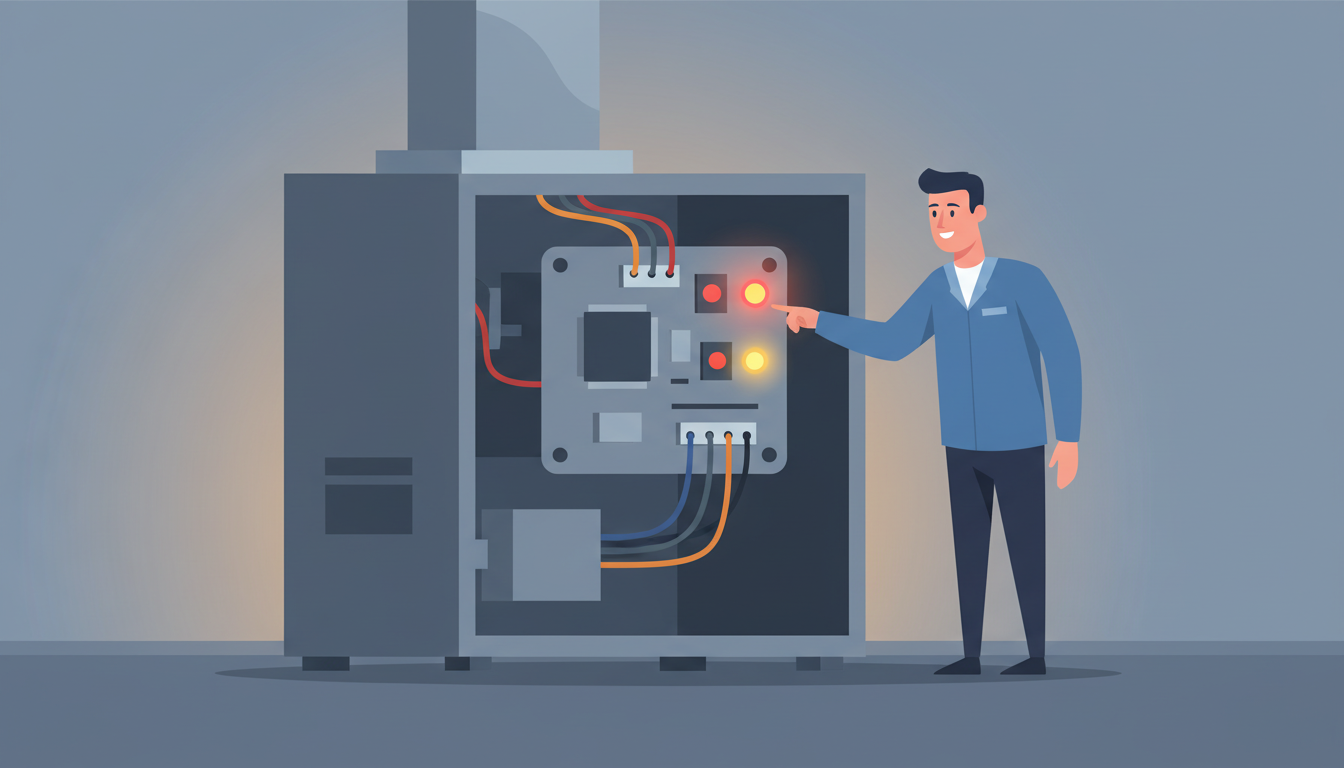
Modern furnaces come equipped with diagnostic LED lights that flash specific patterns to indicate different problems. If you notice flashing lights on your furnace control board, pay close attention to the pattern—it's trying to tell you what's wrong.
Common error codes related to control board failure include:
- Rapid flashing or steady light: Often indicates control board communication failure
- No light at all: Could mean the control board has no power or is completely dead
- Specific flash patterns: Consult your furnace manual, as different manufacturers use different codes
These diagnostic lights are your furnace's way of communicating. Don't ignore them—they can help you or your HVAC technician diagnose the problem quickly.
6. Strange Electrical Issues and Random Operation
Is your furnace behaving erratically? Maybe it turns on and off at odd times, ignores your thermostat commands, or seems to have a mind of its own. These bizarre electrical issues are hallmark signs of a failing control board.
The control board contains numerous electrical components, relays, and circuits. As these components age or get damaged, they can send incorrect signals or misinterpret input from sensors and thermostats. This results in unpredictable furnace behavior that makes no logical sense.
If your smart thermostat is showing error messages or losing connection with your furnace, the control board could be at fault. The board needs to properly communicate with modern digital thermostats, and when it can't, you'll experience connectivity problems.
7. Unusual Noises or Burning Smells
Certain sounds and smells can indicate control board problems:
- Repeated clicking: This clicking sound often means the control board is attempting to start the ignition sequence but failing
- Burning smell or electrical odor: A strong burning smell coming from your furnace cabinet could indicate overheating or burning components on the control board
- Visual damage: If you can safely access your control board (with power off), look for visible burn marks, discolored areas, or melted components
Never ignore burning smells. If you detect a strong electrical or burning odor, turn off your furnace immediately and call a professional. This could indicate a serious fire hazard.
What Causes Furnace Control Boards to Fail?
Understanding why control boards fail can help you prevent future problems. Here are the most common causes:
Age and Normal Wear
Like all electronic components, furnace control boards have a limited lifespan. Most control boards last 10-15 years, though some fail sooner depending on usage and environmental factors. As the board ages, its circuits and relays simply wear out.
Power Surges and Electrical Issues
Power surges from lightning strikes or electrical grid fluctuations can damage the sensitive electronics on your control board. Even minor voltage spikes can degrade components over time, eventually leading to failure.
Consider installing a whole-house surge protector if you live in an area with frequent storms or unreliable power.
Poor Airflow and Overheating
When your furnace doesn't get proper airflow—usually due to a dirty air filter or blocked vents—it overheats. This excessive heat doesn't just affect your heat exchanger; it can also damage your control board and other electrical components.
Overheating is one of the most preventable causes of control board failure. Simply changing your air filter regularly can significantly extend your control board's life.
Moisture and Dust Buildup
Furnace control boards are vulnerable to moisture and dust. If your furnace is located in a damp basement or dusty attic, moisture can corrode the board's circuits, while dust can create short circuits or block ventilation.
Humidity from a nearby water heater, leaking pipes, or poor ventilation can accelerate control board deterioration.
Loose Wiring and Vibration
Over time, the constant vibration from your furnace's blower motor can loosen electrical connections to the control board. Loose wires create resistance, which generates heat and can damage the board or cause intermittent failures.
How to Troubleshoot a Bad Furnace Control Board
If you suspect your control board is failing, here are some basic troubleshooting steps you can take before calling a professional:
Step 1: Check the Power Supply
First, verify that your furnace is receiving power. Check your circuit breaker box to make sure the furnace breaker hasn't tripped. Also check the power switch near your furnace (it often looks like a regular light switch).
Step 2: Inspect the Diagnostic Lights
Locate the LED indicator light on your control board. Is it lit? Is it flashing in a pattern? Consult your furnace's manual to decode the flash pattern. No light at all usually means no power to the board or a completely dead board.
Step 3: Replace the Air Filter
A clogged air filter is one of the most common causes of furnace problems. Replace your filter and see if your symptoms improve. Poor airflow can trigger safety switches that prevent your furnace from operating normally.
Step 4: Reset Your Furnace
Try resetting your furnace by turning it off at the power switch or circuit breaker, waiting 60 seconds, then turning it back on. Sometimes a simple reset can clear minor glitches.
If you've tried basic troubleshooting and your furnace still isn't working properly, it's time to call a professional HVAC technician for a thorough diagnosis.
Can You Replace a Furnace Control Board Yourself?
While it's technically possible to replace a furnace control board yourself if you're handy with electrical work, we generally don't recommend it for most homeowners. Here's why:
Complexity: Control boards have multiple wire connections that must be reattached correctly. One wrong connection can damage your new board or other furnace components.
Safety risks: Working with furnace electrical systems involves risk of electric shock and potential gas leaks if you disconnect the wrong components.
Warranty concerns: DIY repairs often void manufacturer warranties and may violate local building codes.
Diagnosis accuracy: What seems like a control board problem might actually be a failed flame sensor, limit switch, or other component. Professional technicians have the tools to diagnose accurately.
If you do decide to attempt a DIY replacement:
- Take detailed photos before disconnecting any wires
- Turn off all power to the furnace at the breaker
- Purchase the exact replacement board for your furnace model
- Label every wire connection
- Follow the manufacturer's installation instructions precisely
For most homeowners, the safest and most cost-effective option is hiring a qualified HVAC technician. You can learn more about when furnaces trip breakers in our guide on furnace breaker issues.
Furnace Control Board Replacement Cost
The cost to replace a furnace control board typically ranges from $200 to $600, including both parts and labor. Here's how the costs break down:
Parts only: Control boards themselves cost between $80 and $350, depending on your furnace brand and model. High-efficiency furnaces and newer models with advanced features tend to have more expensive boards.
Labor costs: Professional installation typically adds $120 to $250 to the total. The job usually takes 1-2 hours.
Factors affecting cost:
- Furnace brand and model (proprietary boards cost more)
- Ease of access to the board
- Whether your technician needs to order the part
- Your geographic location
- Time of year (emergency service costs more)
Warranty considerations: Many furnace manufacturers offer 5-10 year warranties on parts. If your furnace is relatively new, your control board replacement might be covered, though you'll still pay for labor.
Should You Repair or Replace Your Furnace?
When facing a control board replacement, many homeowners wonder whether it makes more sense to repair the furnace or replace the entire unit. Consider these factors:
Repair if:
- Your furnace is less than 10 years old
- The rest of your furnace is in good condition
- Your furnace is still under warranty
- The repair cost is less than 30% of replacement cost
Replace if:
- Your furnace is 15+ years old
- You've had multiple recent repairs
- Your energy bills have been increasing significantly
- The repair costs more than 50% of a new furnace
- You're planning to stay in your home long-term
A good rule of thumb is the "5,000 rule": multiply the age of your furnace by the repair cost. If the result exceeds $5,000, replacement is usually the better investment.
How to Prevent Furnace Control Board Failure
While you can't prevent control board failure entirely, you can significantly extend its lifespan with proper maintenance:
Change your air filter regularly: This is the single most important thing you can do. Replace filters every 1-3 months depending on usage.
Schedule annual maintenance: Have a professional HVAC technician inspect and tune up your furnace every fall before heating season.
Keep the area clean and dry: Ensure your furnace has good ventilation and is protected from moisture and excessive dust.
Install a surge protector: Protect your furnace from power surges with a whole-house surge protector or a dedicated surge protector for your HVAC system.
Don't ignore minor issues: Small problems like strange noises or minor temperature fluctuations often indicate larger issues developing. Address them early.
Maintain proper clearance: Keep the area around your furnace clear of storage, debris, and flammable materials to ensure good airflow.
Frequently Asked Questions
How much does it cost to replace a furnace control board?
Furnace control board replacement typically costs between $200 and $600 total, including parts ($80-$350) and labor ($120-$250). The exact cost depends on your furnace brand, model, and local labor rates. High-efficiency furnaces with advanced control boards tend to cost more.
Can I replace a furnace control board myself?
While technically possible for those comfortable with electrical work, we don't recommend DIY control board replacement for most homeowners. The process involves working with both electrical systems and potentially gas lines, creating safety risks. Incorrect installation can damage the new board, void warranties, and create hazardous conditions. Professional installation ensures safety and proper diagnosis.
What causes a furnace control board to fail?
The most common causes of control board failure are age and normal wear (10-15 year lifespan), power surges, overheating from poor airflow, moisture and dust exposure, and loose wiring from vibration. Regular maintenance, particularly changing air filters and protecting against power surges, can prevent many control board failures.
How long does a furnace control board last?
A typical furnace control board lasts 10-15 years with proper maintenance. However, lifespan varies based on usage patterns, environmental conditions, maintenance quality, and exposure to power surges. Furnaces in dusty, humid, or poorly ventilated locations may experience shorter control board lifespans.
Should I repair or replace my furnace if the control board is bad?
If your furnace is less than 10 years old and otherwise in good condition, repair is usually the best choice. Consider replacement if your furnace is 15+ years old, has had multiple recent repairs, or if the repair cost exceeds 50% of a new furnace. Use the "5,000 rule": multiply furnace age by repair cost—if it exceeds $5,000, replace rather than repair.
Conclusion: Don't Ignore Control Board Symptoms
Your furnace control board is a critical component that keeps your entire heating system running smoothly. Recognizing the symptoms of a bad furnace control board early—like your furnace won't turn on, the blower runs constantly, short cycling occurs, or you see error codes flashing—can help you address problems before they escalate into complete system failure.
While some troubleshooting steps are safe for homeowners to attempt, control board diagnosis and replacement is best left to qualified HVAC professionals. They have the expertise to accurately identify the problem, safely install replacement parts, and ensure your entire heating system is operating efficiently.
Remember, regular maintenance is your best defense against control board failure. Change your air filters, schedule annual tune-ups, and address small problems before they become big ones. Your furnace—and your wallet—will thank you.
If you're experiencing any of these symptoms and need professional help, don't wait until you're left in the cold. Contact a licensed HVAC technician to diagnose and repair your furnace control board issues today.